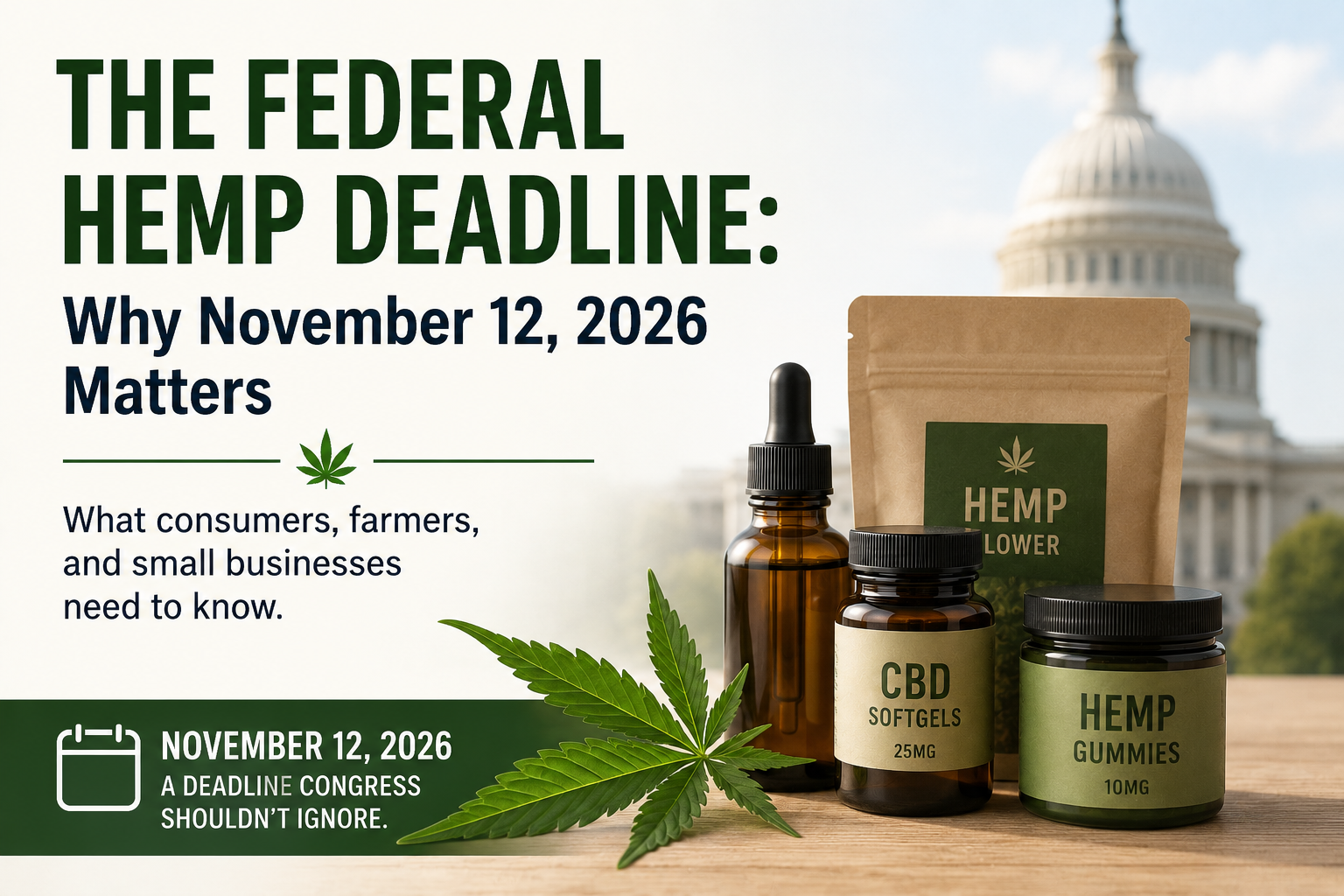
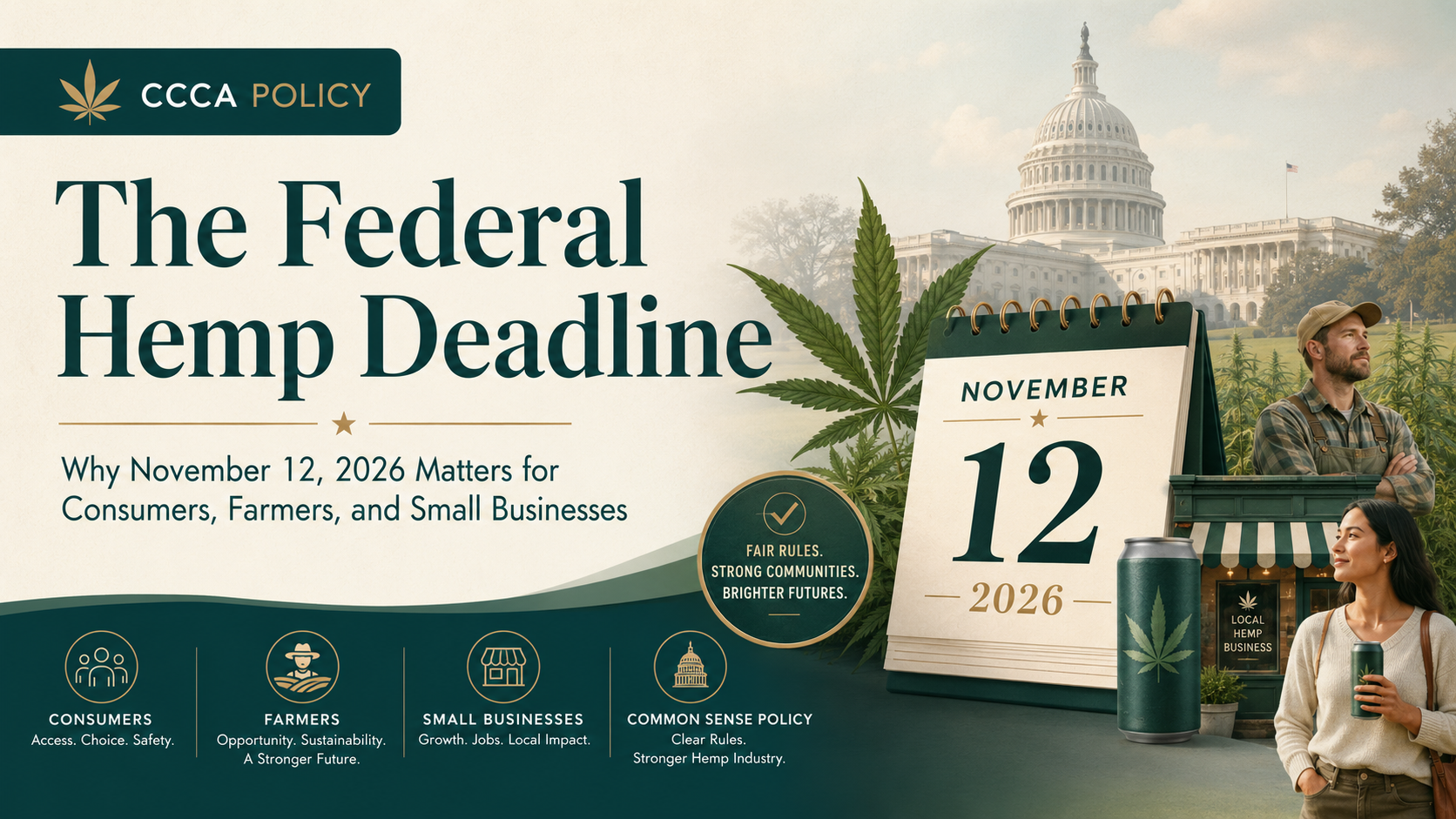
Why November 12, 2026 Matters for Consumers, Farmers, and Small Businesses
Congress has several chances to fix the federal hemp problem. Without action, legal hemp-derived products could face a major federal disruption in late 2026.
In 2018, Congress legalized hemp by defining it as cannabis containing no more than 0.3% delta-9 THC by dry weight. That definition opened the door for farmers, processors, retailers, and consumers to participate in a lawful hemp marketplace.
But that marketplace is now facing a major federal deadline.
A provision passed in the 2025 federal funding package, commonly discussed as Section 781, is scheduled to take effect on November 12, 2026. If Congress does not act before then, federal hemp law will shift away from the 2018 Farm Bill framework and toward a much stricter definition based on total THC, including THCA and certain THC-like cannabinoids. It would also create a very low limit for finished hemp-derived cannabinoid products: roughly 0.4 milligrams of total THC per container.
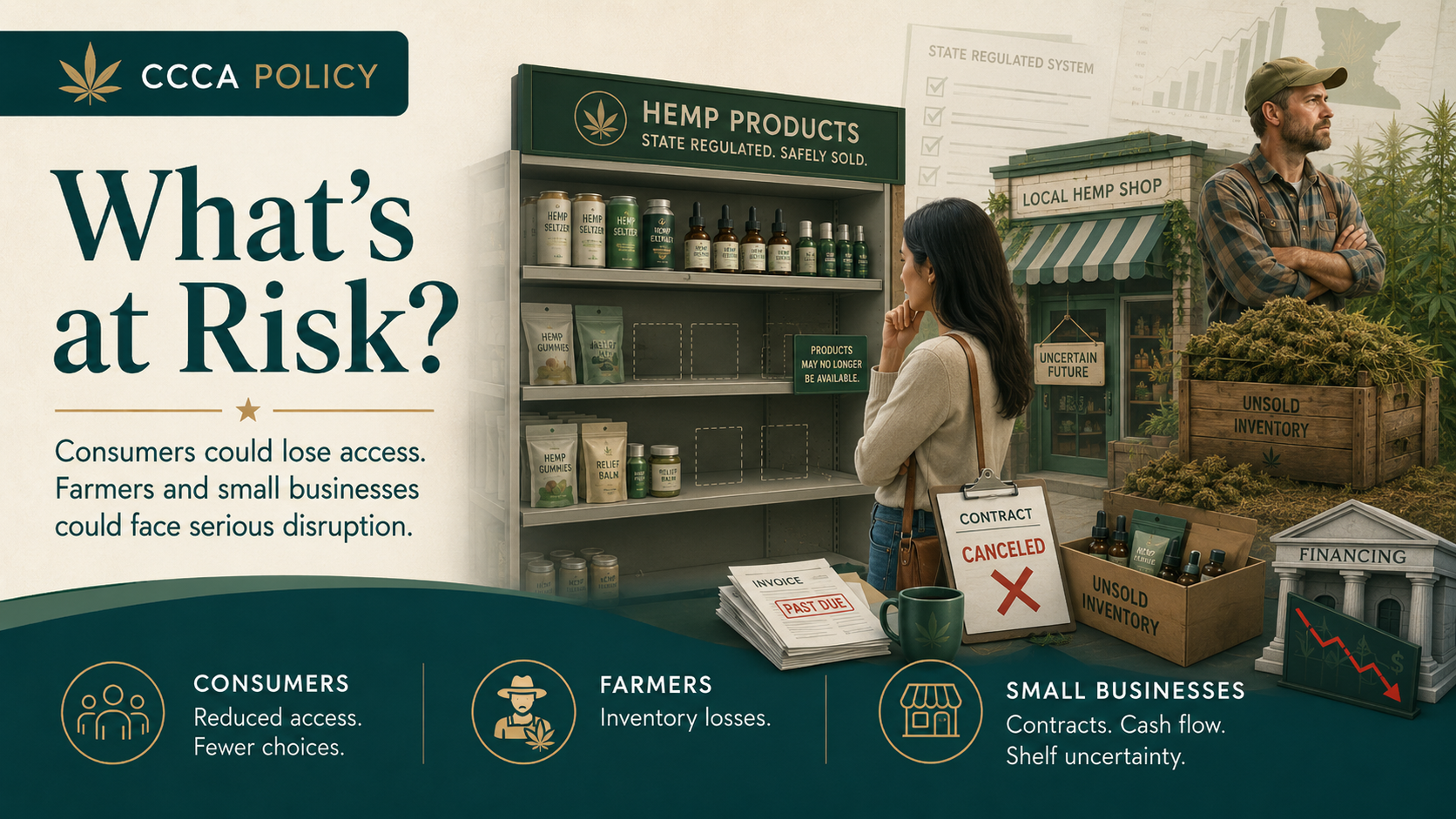
For consumers, this could mean the sudden disappearance of many hemp-derived products that are currently sold legally under state-regulated systems. For farmers and small businesses, it could mean inventory losses, canceled contracts, financing disruptions, and uncertainty about whether products can legally remain on shelves.
CCCA believes the country needs a responsible, transparent, safety-focused hemp framework — not a last-minute federal cliff that pushes consumers toward unregulated markets.
What is the deadline?
The key date is:
November 12, 2026
That is the date the new federal hemp restriction is scheduled to take effect unless Congress delays, repeals, or replaces it.
There is also a second political deadline: the end of the 119th Congress. If bills introduced in this Congress do not become law before the Congress ends, they generally die and must be reintroduced in the next Congress. The Library of Congress explains that a bill that does not become law during the Congress in which it was introduced is considered “dead.”
That means Congress has a limited window to act.
The main federal bills in play
Several bills have been introduced to address the federal hemp issue. They do not all take the same approach.
Some would repeal the upcoming restriction. Some would delay it. Others would create a federal regulatory pathway for hemp-derived cannabinoid products.
1. American Hemp Protection Act — H.R. 6209
The American Hemp Protection Act of 2025 is the clean repeal option. It would repeal Section 781 and prevent the upcoming federal hemp restriction from taking effect. The bill was introduced in the House by Rep. Nancy Mace and referred to the House Agriculture Committee.
What it means:
This is the most direct path for preserving the 2018 Farm Bill hemp framework.
Practical deadline:
It would need to pass before November 12, 2026 to prevent disruption.
2. Hemp Planting Predictability Act — H.R. 7024 / S. 3686
The Hemp Planting Predictability Act is the delay option. The House version, H.R. 7024, would delay implementation of the hemp changes in Public Law 119-37.
This approach would not permanently solve the federal hemp problem, but it would give Congress, regulators, farmers, businesses, and consumers more time to create a workable system. Industry groups have described the bill as a way to extend the implementation timeline for recent federal hemp changes.
What it means:
This bill buys time.
Practical deadline:
It would need to pass before November 12, 2026 to prevent the restriction from taking effect on schedule.
3. Cannabinoid Safety and Regulation Act — S. 3474
The Cannabinoid Safety and Regulation Act would create a federal regulatory framework for cannabinoid products. Instead of banning the market outright, it would regulate products through testing, manufacturing standards, labeling, packaging rules, age restrictions, and other safety requirements.
What it means:
This is a “regulate, don’t prohibit” approach.
Why CCCA should care:
Consumers deserve accurate labels, verified potency, contaminant testing, and clear rules. A regulated pathway is better than pushing products into gray or illicit markets.
Practical deadline:
To prevent disruption, a regulatory framework would need to be enacted before November 12, 2026, or paired with a delay.
4. HEMP Act — H.R. 7212
The Hemp Enforcement, Modernization, and Protection Act, or HEMP Act, would amend the Federal Food, Drug, and Cosmetic Act to create a pathway for cannabinoid hemp products. It was introduced by Rep. Morgan Griffith and referred to the House Energy and Commerce Committee.
This bill is another regulatory pathway option. It focuses on bringing hemp-derived cannabinoid products into a defined federal structure rather than eliminating them entirely.
What it means:
This is a federal product-regulation model.
Practical deadline:
Like the other reform bills, it would need to move before the November 2026 deadline to prevent market disruption.
5. Hemp Safety Enforcement Act — S. 4315
The Hemp Safety Enforcement Act would allow states and Tribes to maintain certain hemp laws and regulatory systems. It was introduced in the Senate by Rand Paul, with Amy Klobuchar and Joni Ernst as cosponsors, and referred to the Senate Agriculture, Nutrition, and Forestry Committee.
This bill matters because many states have already created their own hemp-derived product rules. Some states impose age restrictions, testing requirements, potency limits, licensing, labeling rules, or other safeguards.
What it means:
This is a state-choice approach.
Why CCCA should care:
A state opt-out or state-preservation model could help protect responsible state-regulated hemp markets from a one-size-fits-all federal shutdown.
6. 2026 Farm Bill — H.R. 7567
The House passed the Farm, Food, and National Security Act of 2026, also known as the 2026 Farm Bill, on April 30, 2026, by a vote of 224–200.
The Farm Bill includes hemp-related provisions, particularly around hemp production and agricultural regulation. However, reporting on the House-passed version indicates that it did not delay the scheduled federal restriction on intoxicating hemp products.
What it means:
The Farm Bill is still important, but as currently reported, it is not the clean fix for hemp-derived consumer products.
Why this matters for consumers
This issue is often framed as an industry fight, but it is also a consumer-access issue.
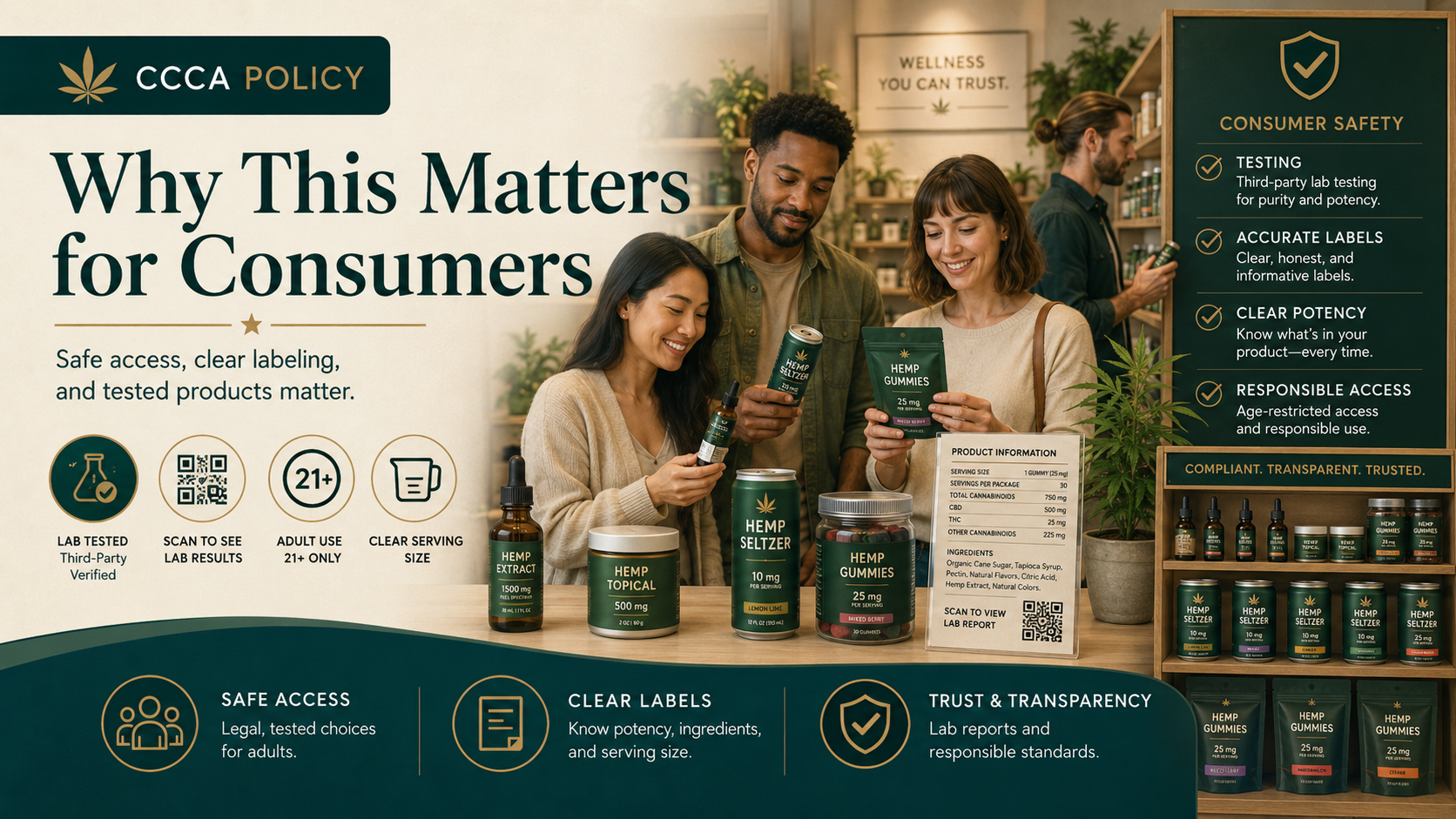
Many adults use hemp-derived products for relaxation, sleep, pain management, alcohol substitution, or general wellness. Others rely on CBD-rich or full-spectrum products that could be affected by overly broad THC definitions.
If federal law removes legal, tested, labeled products from the market without creating a realistic regulated pathway, consumers may not simply stop using cannabinoids. Some will move to unregulated online sellers, illicit markets, or products with less testing and less accountability.
That is not consumer safety.
Real consumer safety means:
Clear age restrictions
Accurate potency labeling
Contaminant testing
QR-code access to lab reports
Good manufacturing practices
Responsible serving sizes
Packaging that prevents accidental youth access
Enforcement against bad actors
A federal ban without a regulated pathway does not solve the safety problem. It may make it worse.
Why this matters for small businesses and farmers
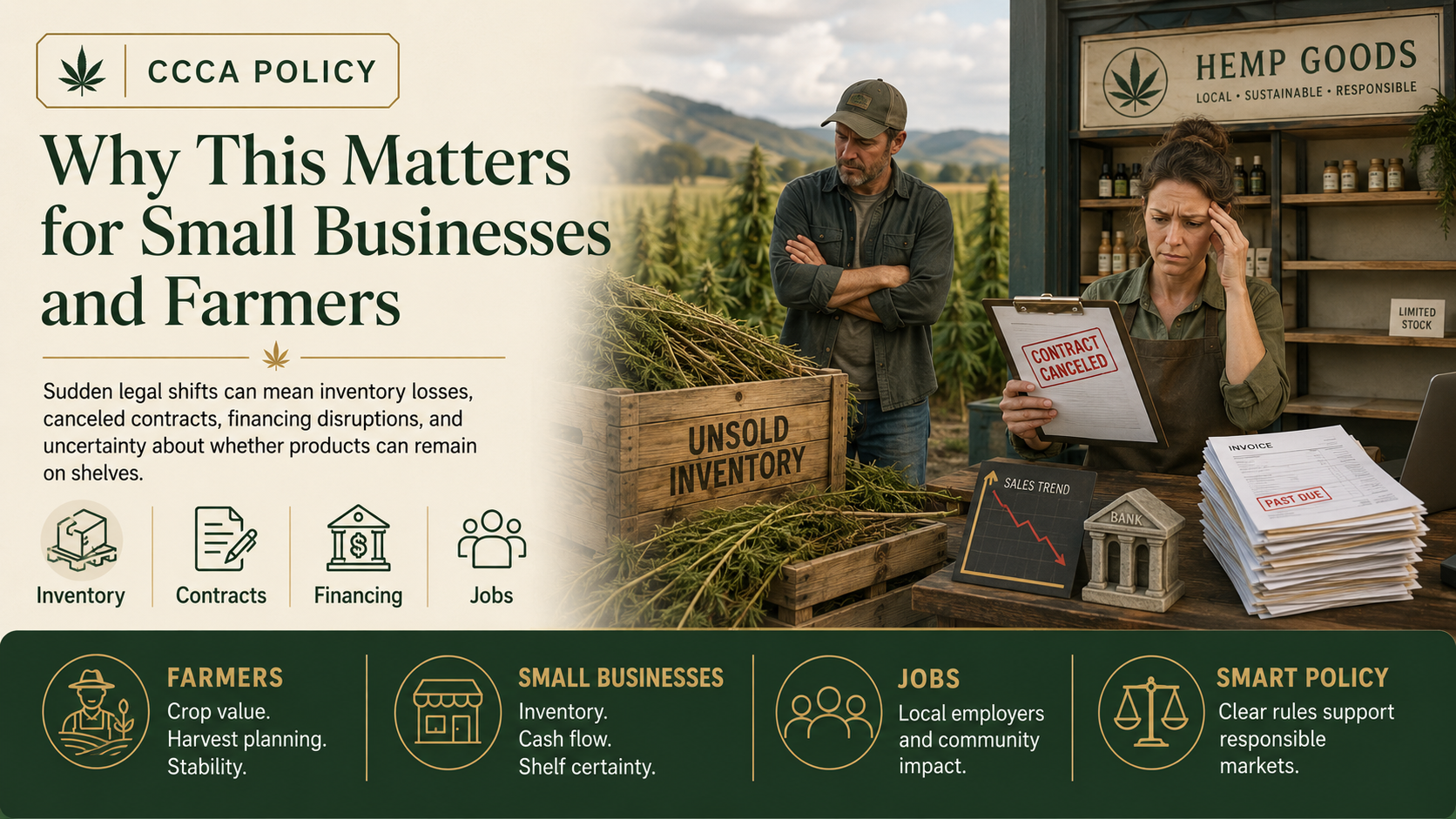
The hemp economy was built around a federal promise: hemp was lawful if it stayed within the 2018 Farm Bill definition.
Farmers planted crops. Processors bought equipment. Beverage companies developed formulations. Retailers built compliant product categories. Labs, packaging companies, distributors, and logistics providers all grew around the legal hemp market.
A sudden federal change could harm more than cannabinoid brands. It could affect:
Hemp farmers
Co-packers and beverage manufacturers
Testing labs
Retail stores
Distributors
Packaging suppliers
Extraction companies
Small rural businesses
Consumers in states with no adult-use cannabis access
This is why Congress should not allow the market to fall off a legal cliff.
CCCA’s position
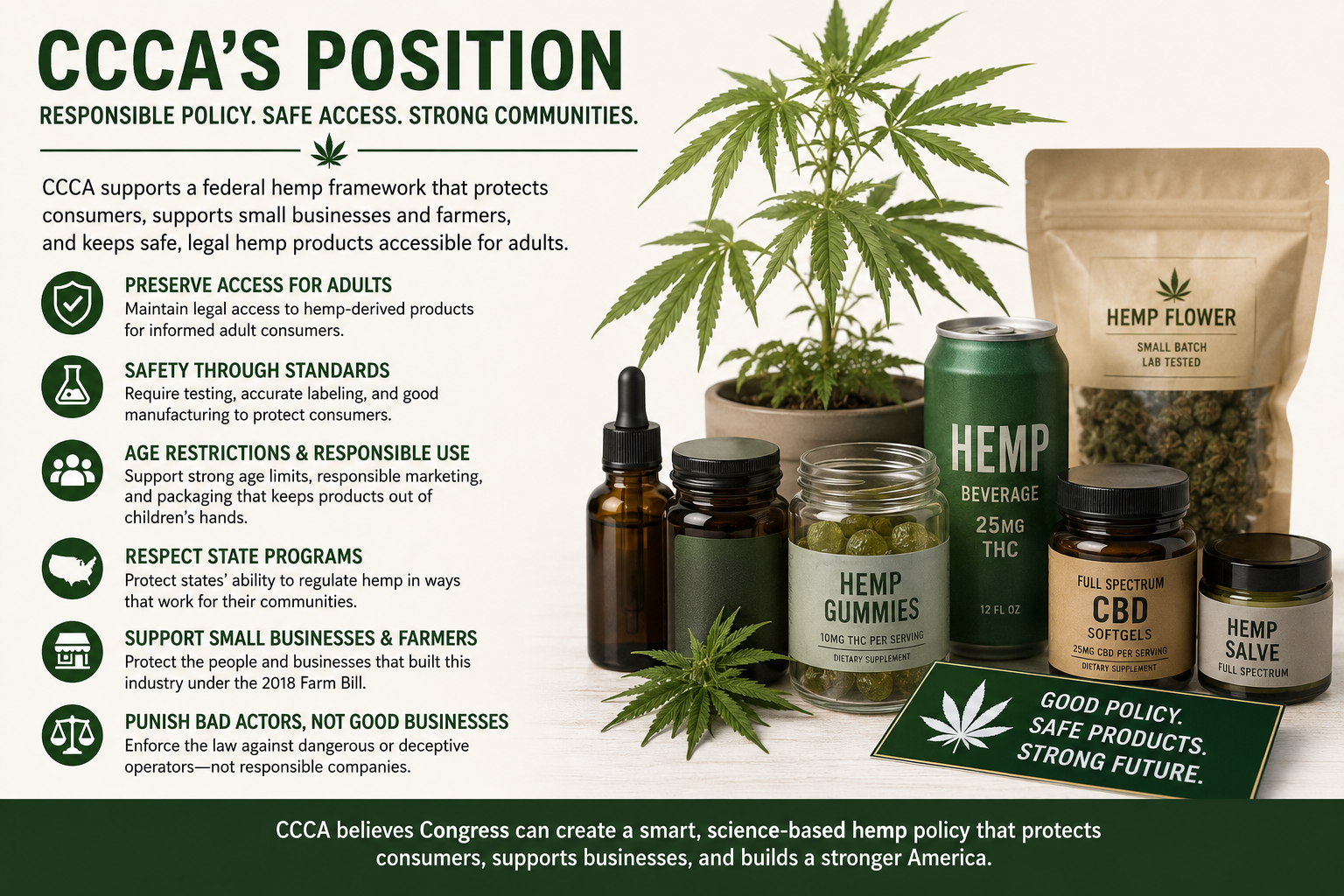
CCCA supports a responsible federal hemp framework that protects consumers while preserving safe access.
We believe Congress should act before November 12, 2026 to avoid unnecessary disruption.
A good federal solution should:
Preserve access for adults to legal hemp-derived products.
Require testing and transparency so consumers know what they are buying.
Set reasonable age restrictions for intoxicating products.
Distinguish intoxicating products from non-intoxicating CBD and full-spectrum wellness products.
Protect state programs that already regulate hemp responsibly.
Support farmers and small businesses that built lawful operations under the 2018 Farm Bill.
Punish unsafe actors without destroying compliant companies.
The choice should not be between prohibition and chaos. The right answer is regulation, accountability, and safe access.
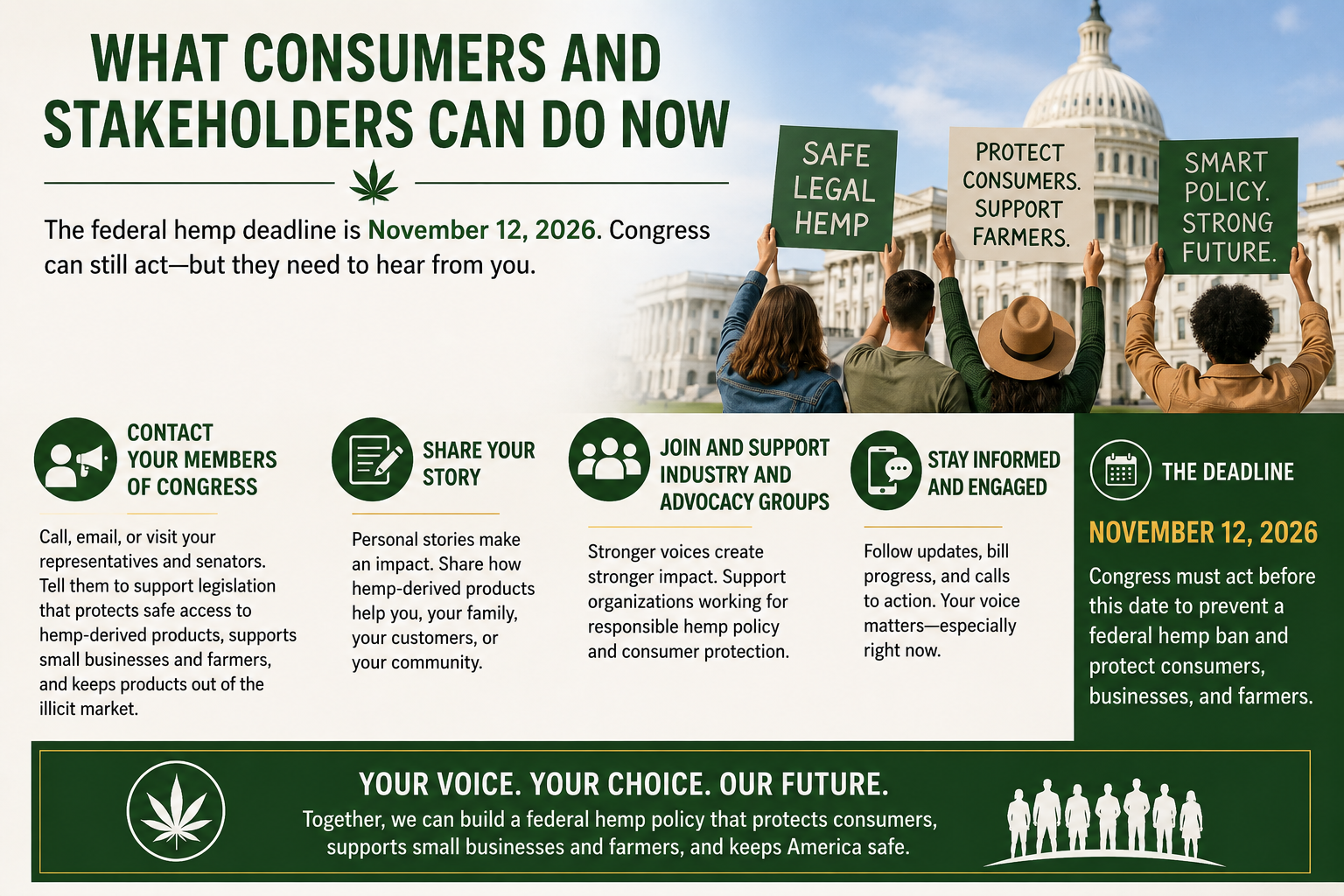
What consumers and stakeholders can do now
Consumers, farmers, retailers, manufacturers, and advocates should pay attention to these federal bills and contact their members of Congress.
The message can be simple:
Congress should not allow the federal hemp market to collapse on November 12, 2026. Lawmakers should pass legislation that preserves safe adult access, protects responsible small businesses, requires testing and labeling, and creates a clear regulatory pathway for hemp-derived cannabinoid products.
The hemp market needs rules.
Consumers need safety.
Small businesses need certainty.
And Congress needs to act before the deadline.
The CCCA Field Guide
It All Begins Here
Safe Access. Informed Choice. Stronger Together.
There is a lot of noise around cannabis.
Some people talk about it like it is only a product. Some talk about it like it is only a political issue. Some treat hemp, CBD, THC, medical marijuana, and cannabis wellness products as if they are all the same thing.
They are not.
The Cannabis Consumer Choice Alliance exists to bring clarity to the conversation.
CCCA is a consumer-focused civic organization built around one core idea:
People are safest when they have access to honest information, transparent products, and the freedom to make informed choices.
We believe cannabis and hemp policy should protect consumers, not confuse them. It should promote safety without eliminating access. It should hold bad actors accountable without punishing responsible businesses or limiting the choices available to patients and adults.
This is not about pushing one product, one company, or one political agenda.
This is about consumers.
Why CCCA Exists

Cannabis and hemp products are everywhere now.
There are gummies, drinks, tinctures, topicals, flower, vapes, capsules, oils, balms, medical products, wellness products, CBD products, low-dose THC products, full-spectrum hemp products, and more.
For consumers, that can be empowering.
It can also be overwhelming.
Many people do not know how to read a product label. They may not understand the difference between hemp seed oil and CBD oil. They may not know what a COA is. They may not know how dosage works. They may not understand why one product is legal in one place and restricted in another.
That confusion creates risk.
CCCA exists to help consumers ask better questions before they buy, understand what they are using, and recognize the difference between a transparent product and a questionable one.
Goal One: Consumer Education

Education is the foundation of CCCA.
Our first job is to make cannabis and hemp information easier to understand.
We want consumers to know:
what different product types are;
how THC and CBD differ;
how to read a product label;
why third-party testing matters;
what a Certificate of Analysis means;
how serving size and dosage work;
why “start low and go slow” matters;
how to store products safely away from children and pets;
how to recognize safer, more transparent products.
CCCA does not exist to tell people what to use.
It exists to help people make informed decisions.
A safer consumer is an informed consumer.
Goal Two: Safe Access
We believe access and safety should work together.
Too often, cannabis policy gets framed as a false choice:
Either allow everything with no standards, or ban entire product categories.
We reject that.
Consumers deserve access to safe, lawful, well-labeled, properly tested products. They also deserve protection from misleading labels, unclear dosing, contamination risks, irresponsible packaging, and bad actors.
The answer is not confusion.
The answer is responsible access.
CCCA supports policies and market practices that make it easier for consumers to find products that are clearly labeled, batch-tested, properly packaged, age-appropriate, and honestly represented.
Goal Three: Informed Choice
Consumer choice matters because consumers are not all the same.
Some people want non-intoxicating products.
Some want CBD.
Some want hemp seed oil.
Some want low-dose THC.
Some use medical marijuana.
Some prefer beverages.
Some prefer tinctures.
Some are looking for topicals.
Some want to avoid inhalable products.
Some want natural ingredients.
Some care most about affordability.
Some care most about testing and transparency.
A healthy marketplace should allow room for different needs.
CCCA believes consumers should have access to a full spectrum of safe options — from hemp-based wellness products to regulated medical cannabis — without being forced into one narrow model of access.
More safe choices mean more consumer power.
Goal Four: Responsible Regulation
Good regulation should protect consumers.
Bad regulation can accidentally do the opposite.
When laws are too broad, unclear, or disconnected from how consumers actually use products, they can reduce access, eliminate responsible operators, raise prices, and push people toward unregulated alternatives.
CCCA supports common-sense regulation that focuses on real consumer protection:
clear labels;
accurate potency information;
third-party testing;
batch-specific documentation;
responsible packaging;
age safeguards where appropriate;
transparency around ingredients;
enforcement against unsafe or misleading products;
fair rules for responsible businesses.
Regulation should separate responsible operators from bad actors.
It should not erase safe choices.
Goal Five: A Stronger Consumer Voice
Cannabis policy is often shaped by lawmakers, regulators, large companies, lobbyists, and industry groups.
Consumers are frequently left out.
CCCA exists to change that.
We want to collect real consumer feedback, hear real stories, understand real access issues, and turn those insights into education, reports, petitions, and policy conversations.
That means asking people:
What products do you use?
What confuses you?
What safety information do you look for?
What products are hard to find?
What policies worry you?
What choices matter to you?
What would help you feel more confident as a consumer?
Those answers matter.
They help lawmakers understand the human side of policy.
They help responsible companies understand what consumers actually need.
They help the public see that cannabis consumers are not a stereotype.
They are patients, parents, veterans, seniors, workers, caregivers, entrepreneurs, and ordinary adults trying to make informed choices.
Goal Six: Transparency Over Hype
The cannabis marketplace has too much hype.
CCCA wants to promote a different standard.
No exaggerated promises.
No confusing labels.
No mystery ingredients.
No fake authority.
No fear-based messaging.
No pretending every product is the same.
Consumers deserve plain language.
They deserve to know what a product contains, how strong it is, who made it, how it was tested, and whether it is appropriate for their needs.
Transparency builds trust.
Trust builds safer markets.
Goal Seven: A Bridge Between Consumers, Companies, and Policymakers
CCCA sits at the intersection of three groups:
Consumers, who need education, safety, access, and choice.
Responsible companies, who need a fair marketplace and better consumer understanding.
Policymakers, who need real-world information before making decisions that affect access, safety, and small businesses.
The goal is not to let any one group dominate the conversation.
The goal is balance.
Consumers should be protected.
Companies should be accountable.
Policymakers should be informed.
Bad actors should be addressed.
Safe choices should remain available.
That is the middle path CCCA is trying to build.
What CCCA Is Not
CCCA is not a product company.
It is not a dispensary.
It is not a cannabis lifestyle brand.
It is not here to tell people they should use cannabis.
It is not here to promote irresponsible consumption.
It is not here to protect bad actors.
It is not here to make cannabis policy more confusing than it already is.
CCCA is here to educate, organize, listen, and advocate for a safer, more transparent consumer marketplace.
What CCCA Is Building
CCCA is building an education-first consumer movement.
That includes:
Cannabis 101 educational articles;
label-reading guides;
COA explainers;
consumer safety checklists;
safe storage education;
product type guides;
public surveys;
local community engagement;
policy education;
consumer reports;
advocacy tools;
events and public conversations.
The long-term goal is simple:
Make consumers more informed, make products more transparent, make policy more responsible, and make access safer.
The CCCA Standard
We believe the future of cannabis should be built around five principles:
1. Safety
Products should be tested, labeled, and responsibly packaged.
2. Access
Consumers and patients should not lose safe options because of unclear or overly broad laws.
3. Choice
Different people need different products. A fair marketplace should reflect that.
4. Transparency
Labels, testing, dosage, ingredients, and manufacturing information should be easy to understand.
5. Accountability
Responsible businesses should be supported, and unsafe or misleading practices should be addressed.
Final Thought
Cannabis is not one thing.
It is a plant family, a marketplace, a policy issue, a patient-access issue, a wellness category, a medical category, and a consumer safety issue all at once.
That complexity is exactly why education matters.
CCCA exists because consumers deserve better than confusion.
They deserve clear information.
They deserve safe access.
They deserve real choices.
They deserve a voice.
Safe Access. Informed Choice. Stronger Together.
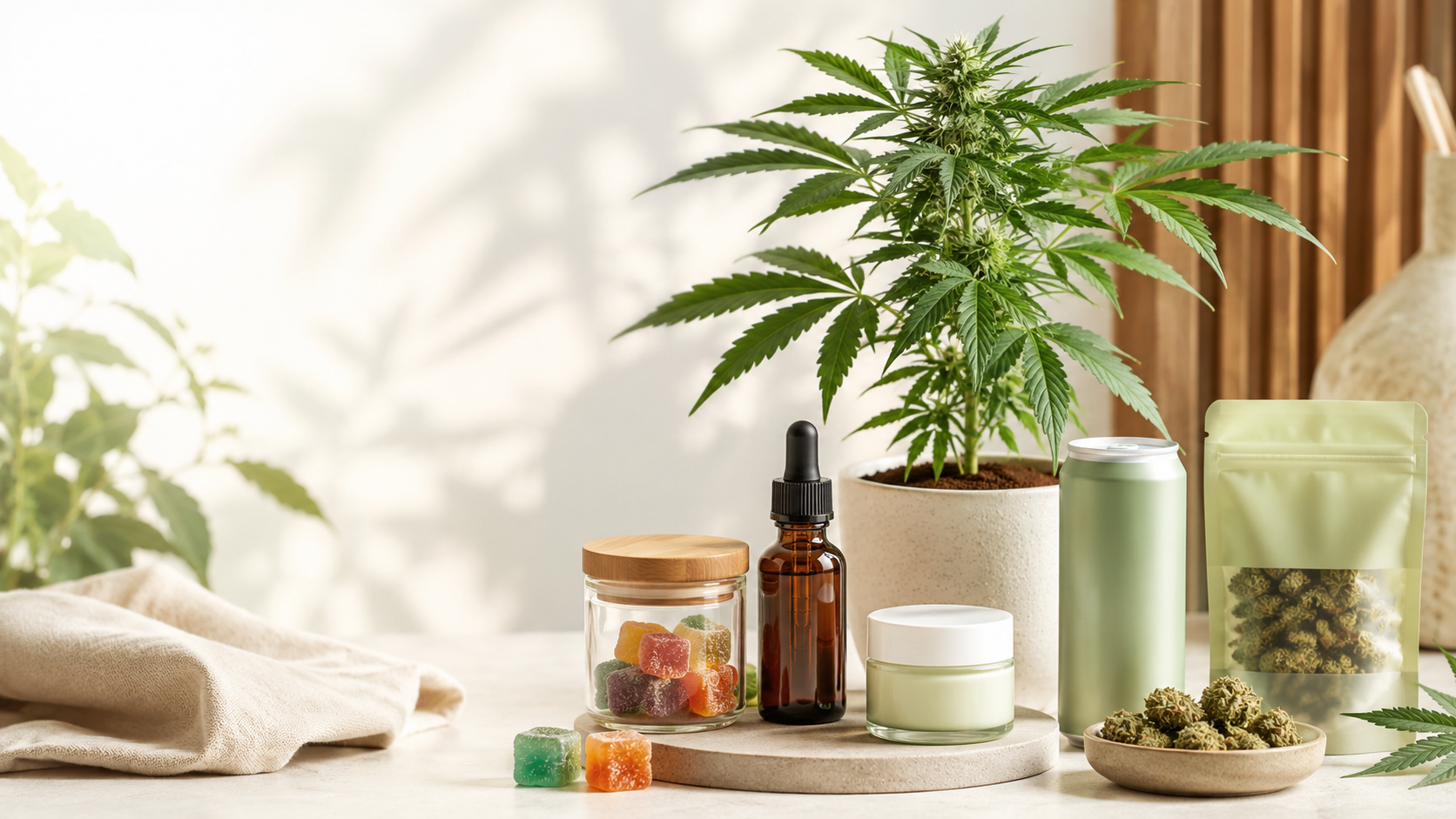
Cannabis 101: A Simple Guide to Safe Access and Informed Choice
It All Begins Here
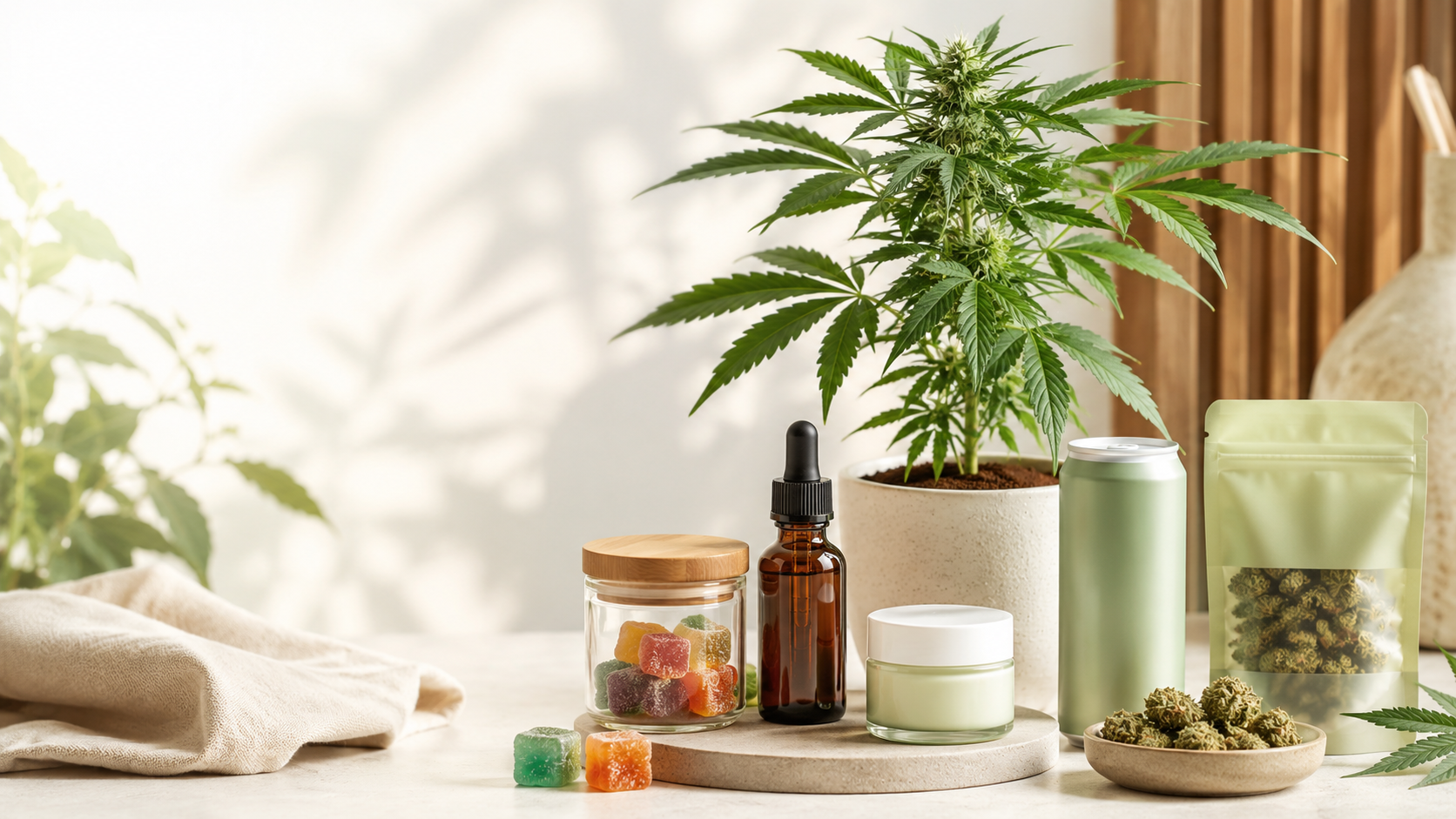
Cannabis and hemp products are becoming more common, but many consumers still feel confused by the language, product types, labels, and laws. That confusion is understandable. Terms like hemp, cannabis, CBD, THC, full-spectrum, medical marijuana, hemp seed oil, and Certificate of Analysis are often used together, even though they can mean very different things.
This guide is designed to give consumers a clear starting point.
At Cannabis Consumer Choice Alliance, we believe people are safest when they have access to honest information, transparent products, and the ability to make informed choices.
What Is Cannabis
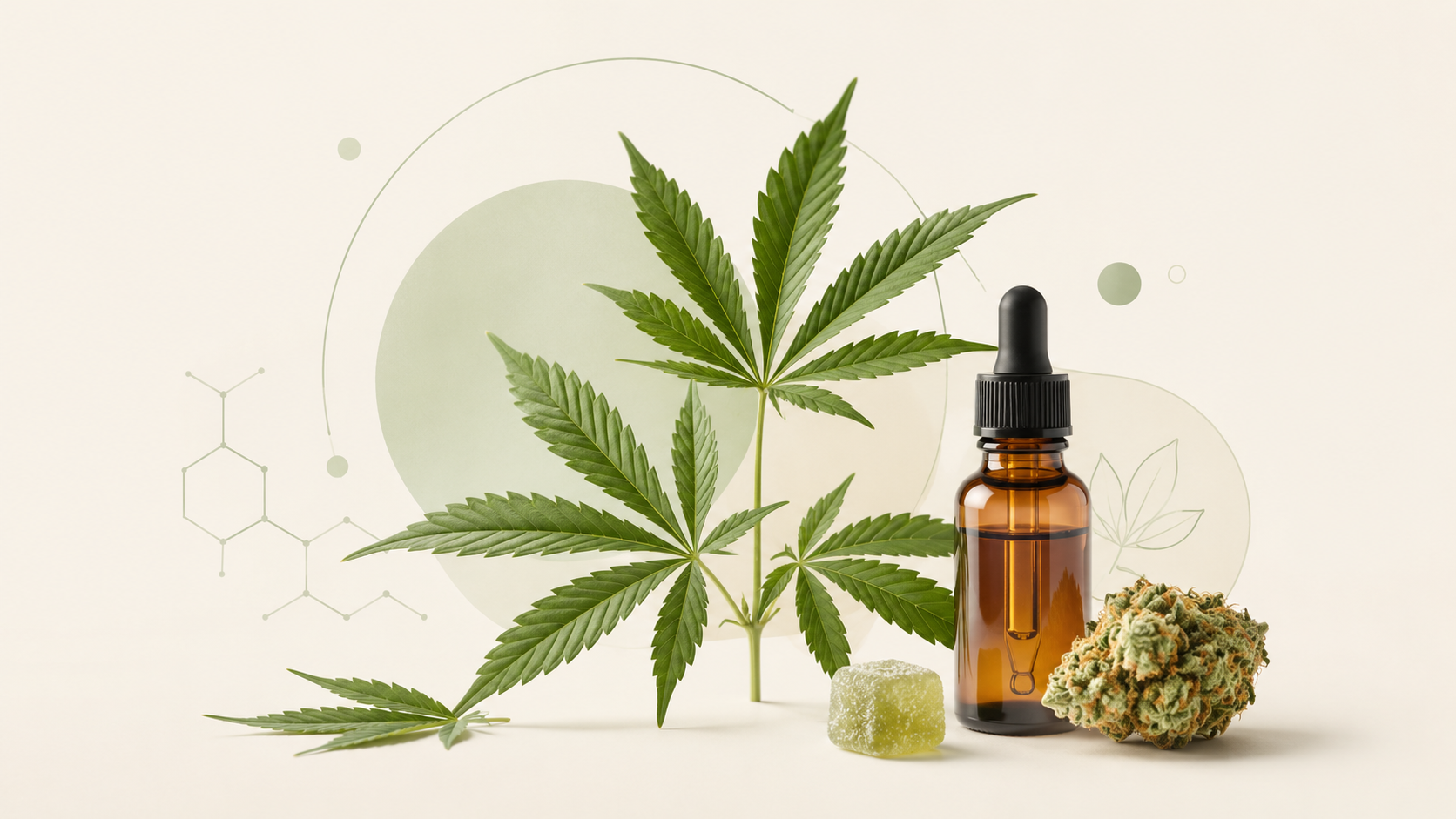
Cannabis is a plant family that includes varieties commonly described as hemp and marijuana. These plants can contain many naturally occurring compounds, including cannabinoids, terpenes, flavonoids, fatty acids, and other botanical components.
The two most commonly discussed cannabinoids are THC and CBD.
THC is the cannabinoid most associated with intoxicating effects.
CBD is non-intoxicating and is commonly used in wellness-oriented products.
Cannabis products can vary widely in strength, ingredients, intended use, and legal classification. That is why consumers should pay attention to labels, testing, dosage, and product type before purchasing or using a product.
Hemp vs. Marijuana
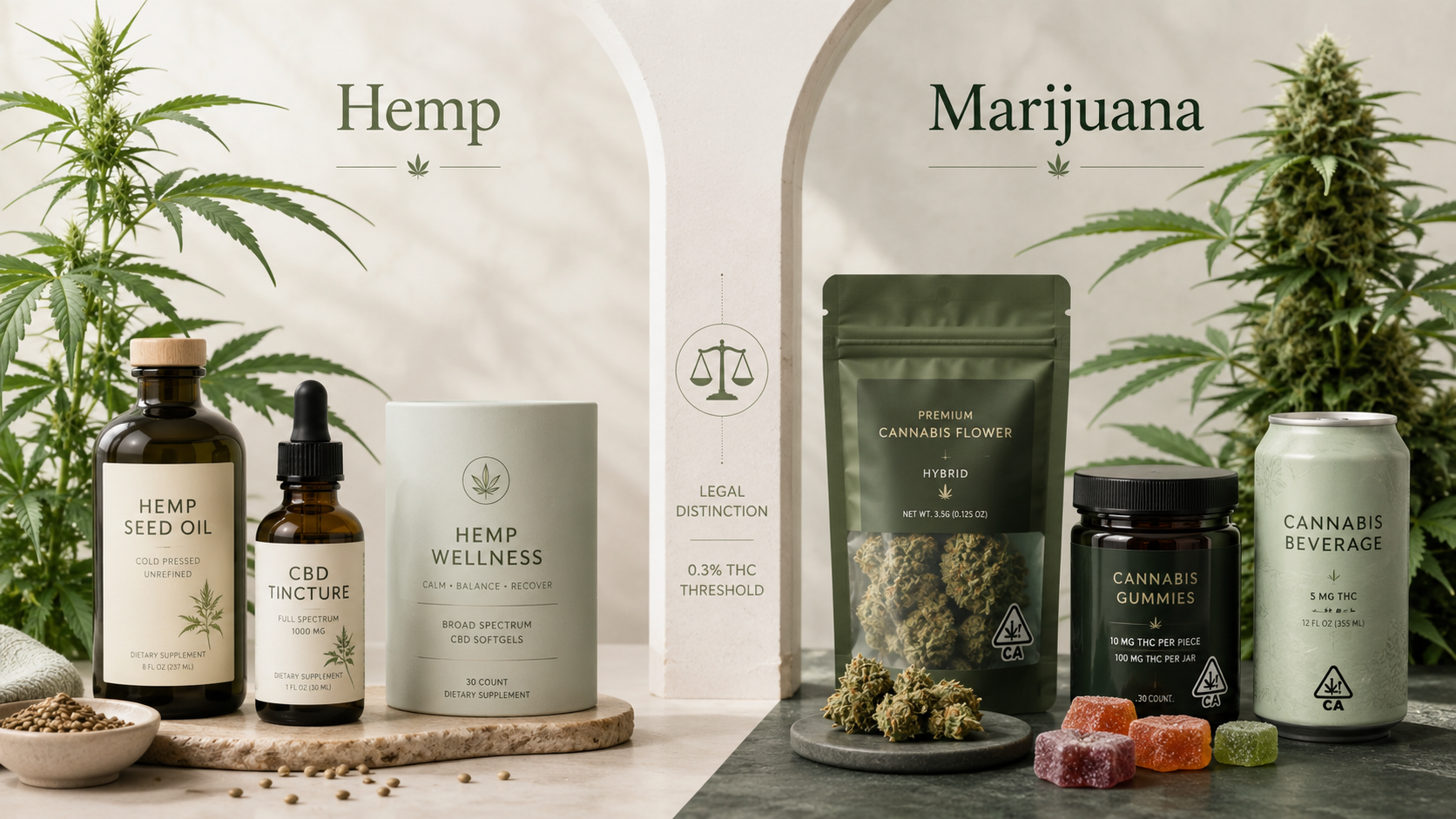
The difference between hemp and marijuana is largely a legal distinction.
In the United States, hemp is generally defined as cannabis containing no more than 0.3% delta-9 THC by dry weight. Marijuana generally refers to cannabis that exceeds that threshold or is regulated under state marijuana programs.
This distinction matters because hemp-derived products and marijuana products may be regulated very differently depending on federal law, state law, product type, and intended use.
For consumers, the main takeaway is simple:
Not all cannabis products are the same, and legal status does not automatically tell you whether a product is safe, appropriate, or well-made.
Hemp Seed Oil Is Not the Same as CBD Oil
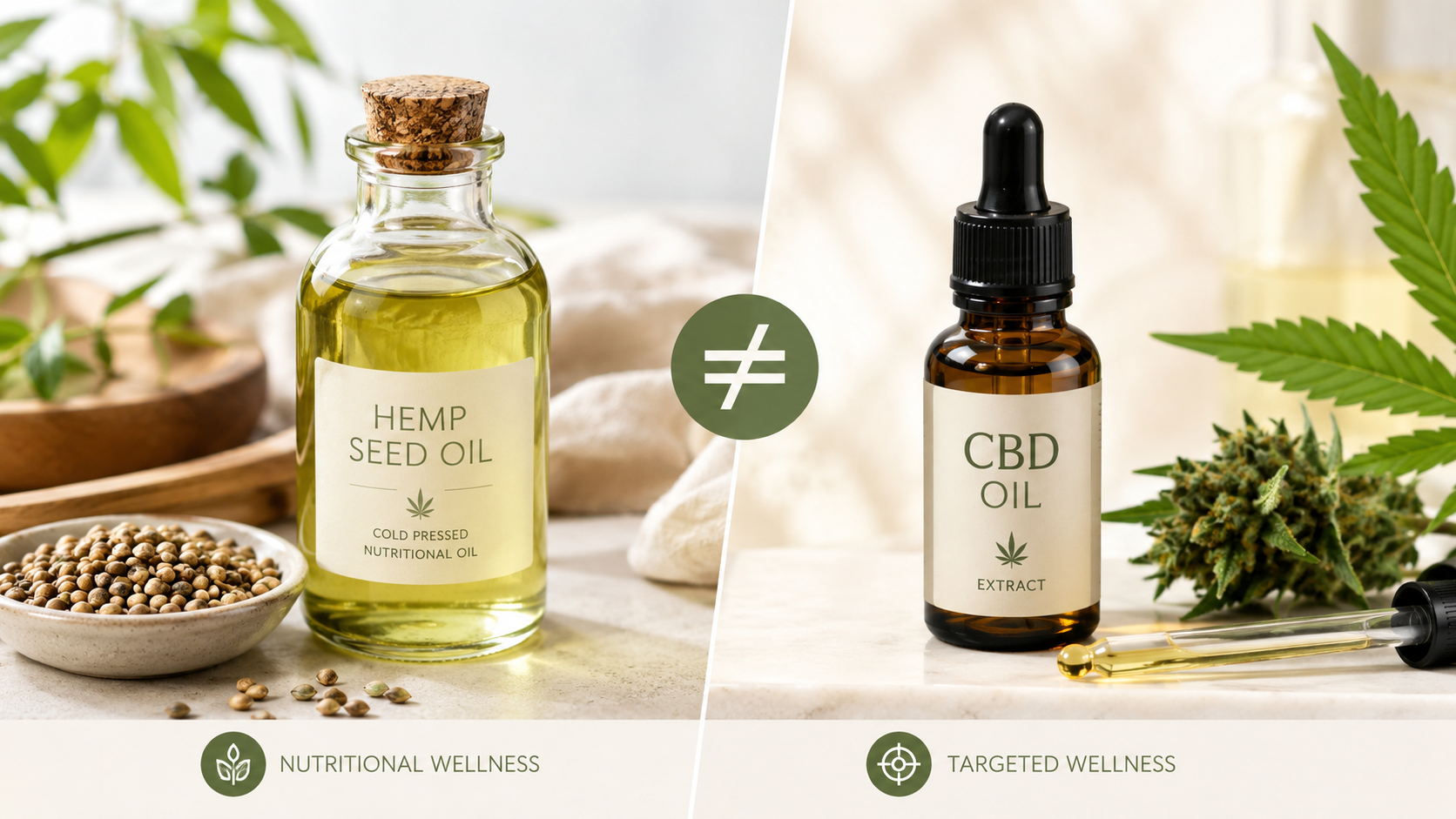
One common source of confusion is the difference between hemp seed oil and CBD oil.
Hemp seed oil is made from the seeds of the hemp plant. It is commonly used as a food oil, cosmetic ingredient, or nutritional oil. It typically does not contain meaningful amounts of CBD or THC.
CBD oil is usually made with extracts from the flower, leaves, or aerial parts of the hemp plant. It may contain CBD and, depending on the product, other cannabinoids.
Both may come from hemp, but they are not the same product.
Consumers should look closely at labels to see whether a product contains actual cannabinoids, how much it contains, and whether testing is available.
Common Cannabis and Hemp Product Types
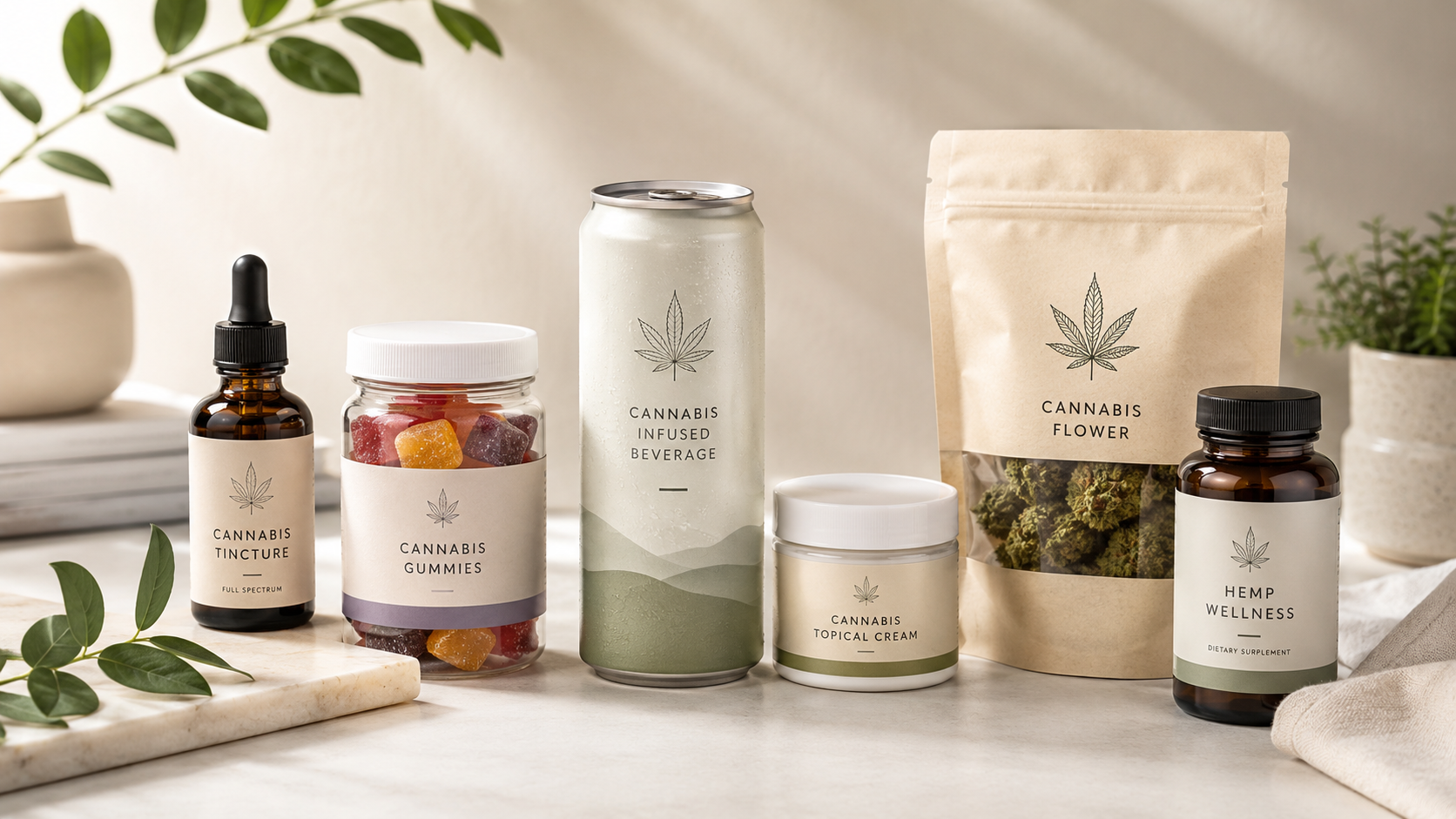
Cannabis and hemp products come in many forms. Each format can feel different, work differently, and require different safety considerations.
Gummies and Edibles
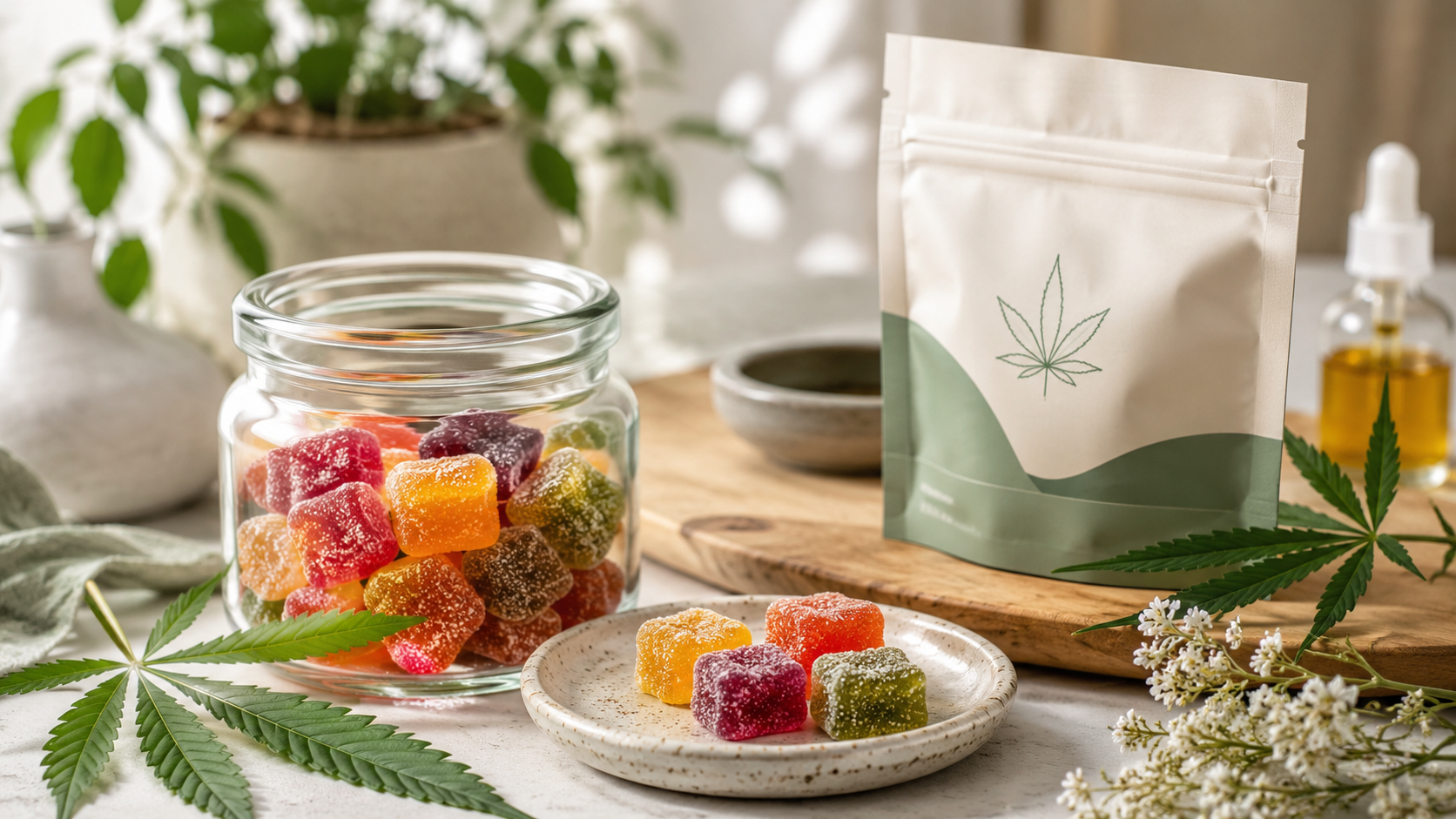
Edibles are eaten and absorbed through digestion. They can take longer to feel, and effects may last longer than other product types. Because delayed onset can lead to overconsumption, consumers should be cautious and patient.
Beverages

Infused beverages are drinks that contain cannabinoids such as CBD, THC, or both. Some consumers like beverages because they can feel familiar and social, similar to other adult beverages. Always check the dose per can or bottle.
Tinctures
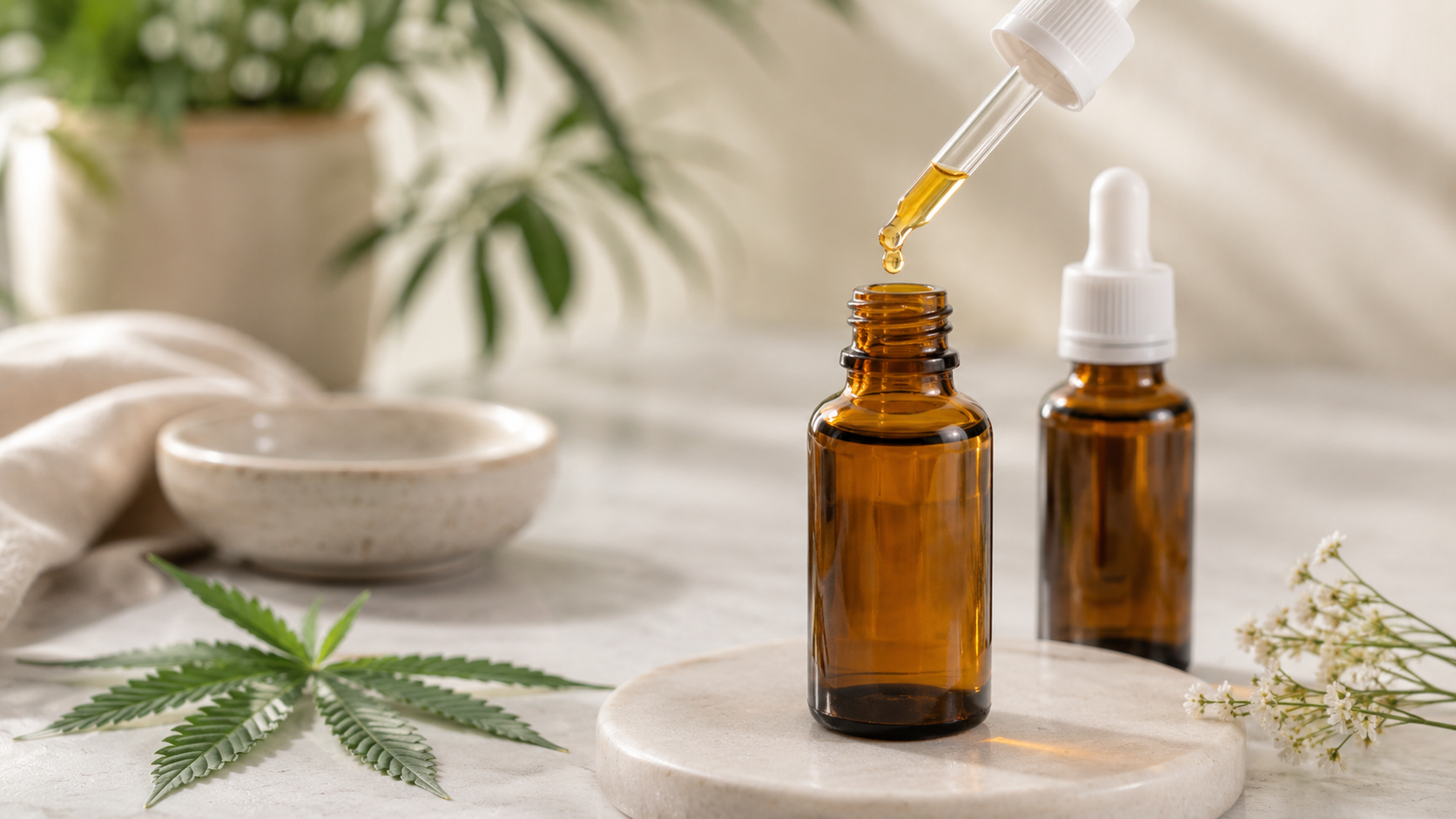
Tinctures are liquid products usually taken by dropper. They may be placed under the tongue or mixed with food or drinks, depending on the product instructions.
Topicals

Topicals are applied to the skin. They may include creams, balms, lotions, or roll-ons. Many topicals are non-intoxicating, but consumers should still review the ingredients and label.
Flower
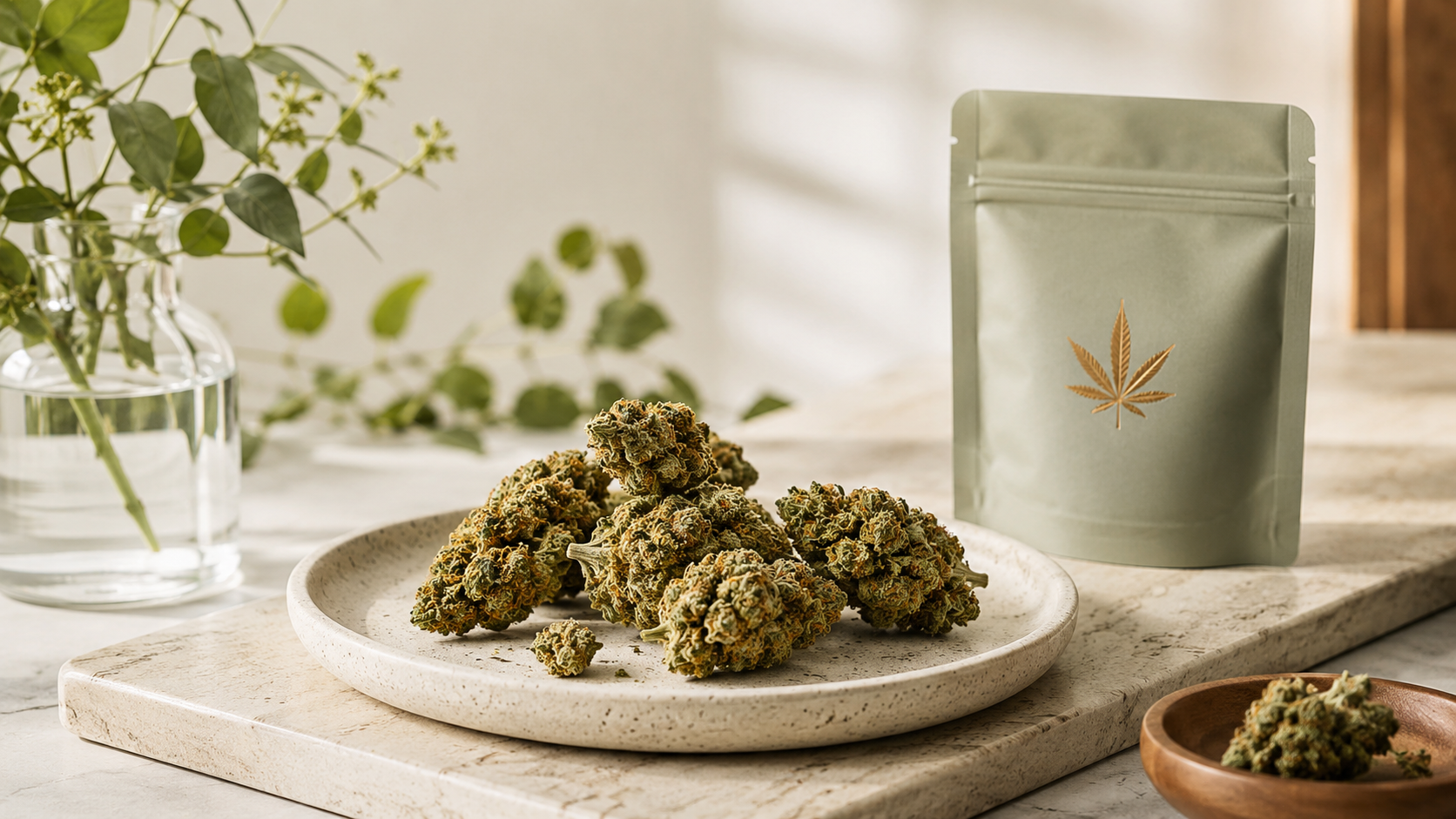
Flower refers to the dried cannabis plant material. It may be smoked or vaporized, depending on the product and local laws. Consumers should understand potency and legal access rules before use.
Vapes

Vape products are inhaled through a vaporizer device. Because inhaled products can raise special safety concerns, consumers should be especially careful about ingredients, testing, hardware quality, and source.
Understanding THC and CBD
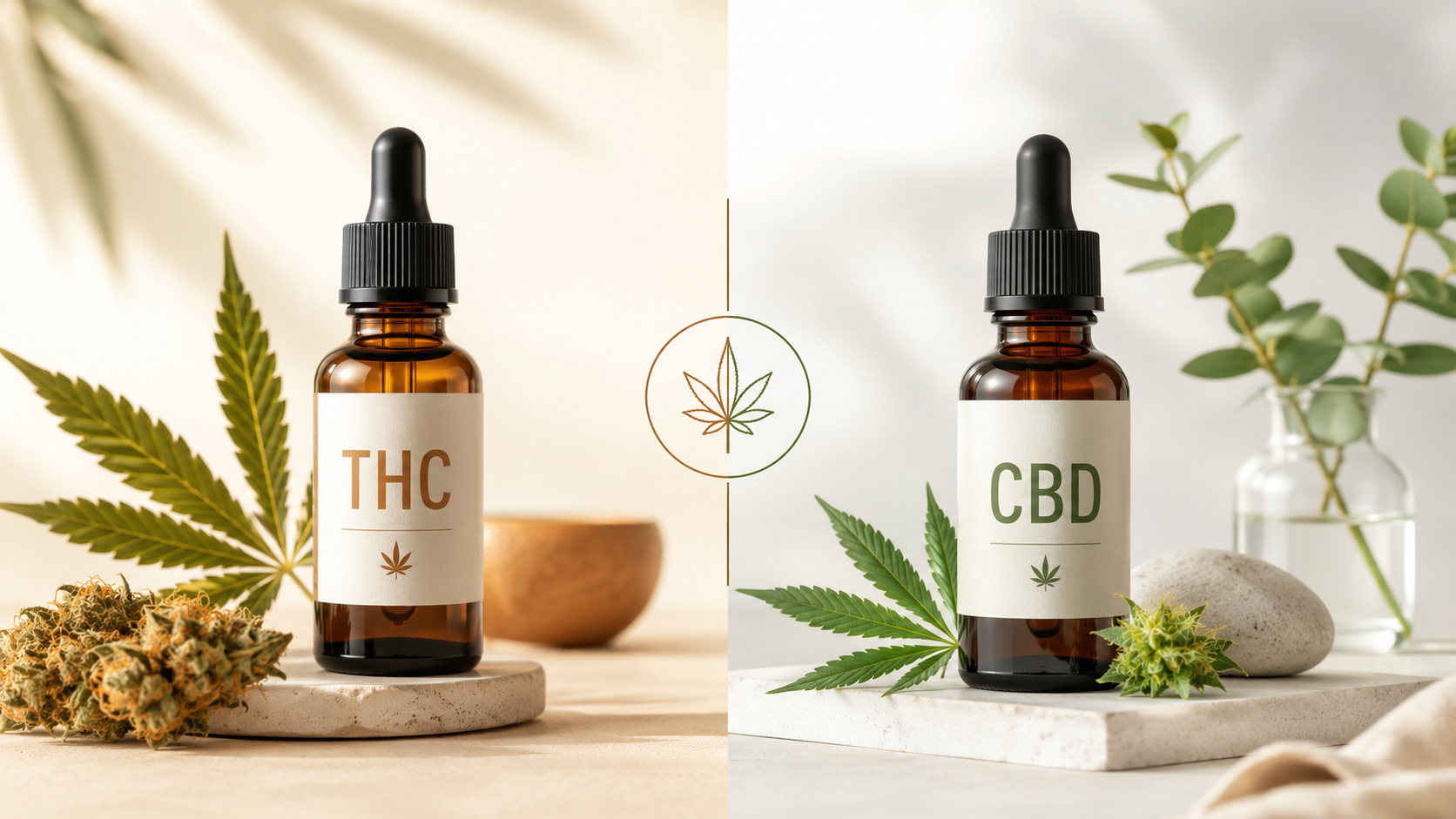
THC
THC can produce intoxicating effects. Depending on dose, tolerance, product type, and individual sensitivity, THC may affect mood, perception, coordination, appetite, and sleepiness.
Consumers using THC should avoid driving or operating machinery and should start with low doses, especially if they are new or returning after a long break.
CBD
CBD is not generally associated with intoxication. Many consumers use CBD products for wellness routines, but product quality can vary. Consumers should look for clear dosage information and third-party testing.
THC + CBD Products
Some products contain both THC and CBD. The ratio between the two cannabinoids can affect the consumer experience. For example, a product with 1 mg THC and 25 mg CBD is very different from a product with 10 mg THC and no CBD.
What Does “Full-Spectrum” Mean?

“Full-spectrum” usually means a product contains multiple compounds from the cannabis or hemp plant, potentially including cannabinoids, terpenes, and other botanical components.
However, the term can be used differently by different companies. Consumers should not rely only on marketing language. A label or lab report should show what the product actually contains.
Other related terms include:
Broad-spectrum: may contain multiple hemp compounds but is often marketed as THC-free or with non-detectable THC.
Isolate: usually refers to a purified single compound, such as CBD isolate.
What Is a COA?
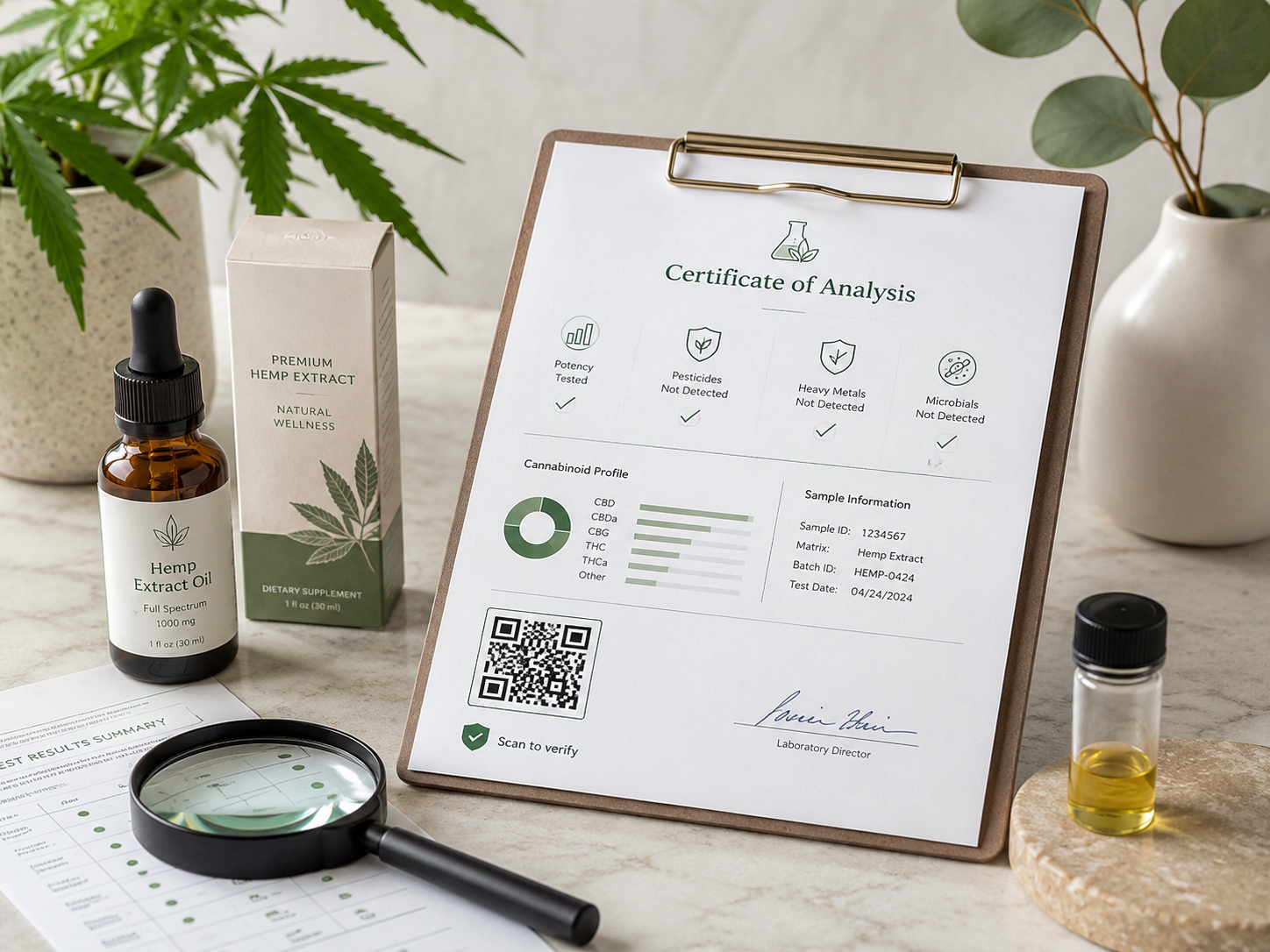
A Certificate of Analysis, often called a COA, is a lab report that provides information about a product or ingredient.
A good COA may show:
cannabinoid potency;
THC and CBD levels;
batch or lot number;
testing date;
lab name;
contaminants such as pesticides, heavy metals, residual solvents, microbes, or mycotoxins, depending on the test panel.
A COA is useful only if it matches the product batch you are buying. If the label has a batch number, the COA should match that batch.
Consumers should be cautious if a company cannot provide testing or if the QR code does not lead to a clear, current report.
How to Read a Product Label
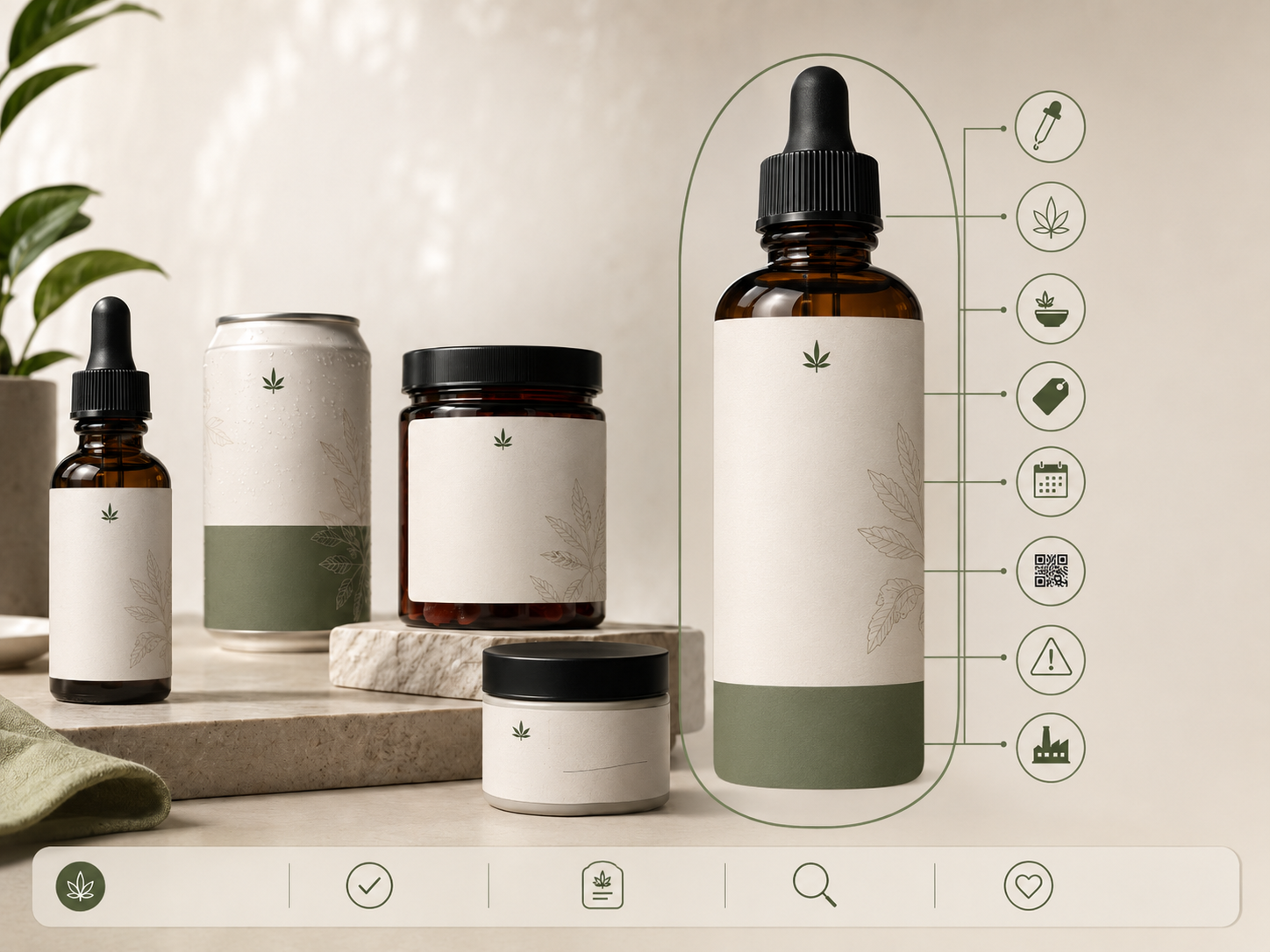
Before buying a cannabis or hemp product, look for:
product name;
serving size;
number of servings per package;
amount of THC, CBD, or other cannabinoids per serving;
total amount per package;
ingredients;
allergen information when relevant;
batch or lot number;
manufacturer or distributor name;
expiration or best-by date;
warnings;
QR code or link to testing;
age restriction where applicable.
A clear label helps consumers make informed decisions. A confusing label is a red flag.
Start Low and Go Slow

This is one of the most important consumer safety principles.
For THC products, especially edibles and beverages, beginners should start with a low amount and wait long enough before taking more. Effects from edible products can take time to appear and may last longer than expected.
A person’s experience can be affected by:
dose;
tolerance;
body size and metabolism;
food intake;
product format;
medications;
alcohol use;
sleep;
stress;
individual sensitivity.
More is not always better. The right amount is the amount that works safely and predictably for the individual consumer.
Safe Storage Matters

Cannabis and hemp products should be stored responsibly.
Consumers should keep products:
away from children;
away from pets;
in original packaging when possible;
clearly labeled;
secured if the product contains THC;
away from heat, moisture, or sunlight if the label recommends it.
Edibles and beverages can sometimes look like ordinary food or drinks. That makes safe storage especially important.
Responsible Regulation Protects Consumers

Consumers are not protected by confusion. They are protected by clear standards.
Responsible cannabis and hemp regulation should support:
accurate labeling;
third-party testing;
honest dosage information;
age-appropriate safeguards;
child-resistant packaging where appropriate;
enforcement against unsafe or misleading products;
fair access for patients and consumers;
product category distinctions;
responsible business practices.
The goal should be safer choices, not fewer choices.
Questions to Ask Before Buying

Before purchasing a cannabis or hemp product, ask:
What is the dose per serving?
How many servings are in the package?
Does the product contain THC, CBD, or both?
Is there a QR code or lab report?
Does the COA match the product batch?
Who manufactured the product?
Are the ingredients clearly listed?
Is the product appropriate for my experience level?
Are there warnings or age restrictions?
Can the retailer answer basic safety questions?
If the answer to these questions is unclear, consider choosing a more transparent product.
Consumer Choice Matters

Cannabis and hemp consumers are not all the same.
Some people want non-intoxicating hemp products. Some want CBD. Some want low-dose THC. Some rely on medical marijuana. Some are looking for alternatives to alcohol. Some care most about price. Others care most about testing, ingredients, or local availability.
A healthy marketplace gives consumers safe, lawful, transparent choices.
More safe choices mean more consumer power.
Final Thought
Cannabis 101 is not about telling people what to use. It is about helping people understand what questions to ask.
The safest consumer is an informed consumer.
At Cannabis Consumer Choice Alliance, we believe education, transparency, responsible regulation, and consumer choice should work together. People deserve access to safe products, honest information, and policies that reflect real-world needs.
Safe Access. Informed Choice. Stronger Together.