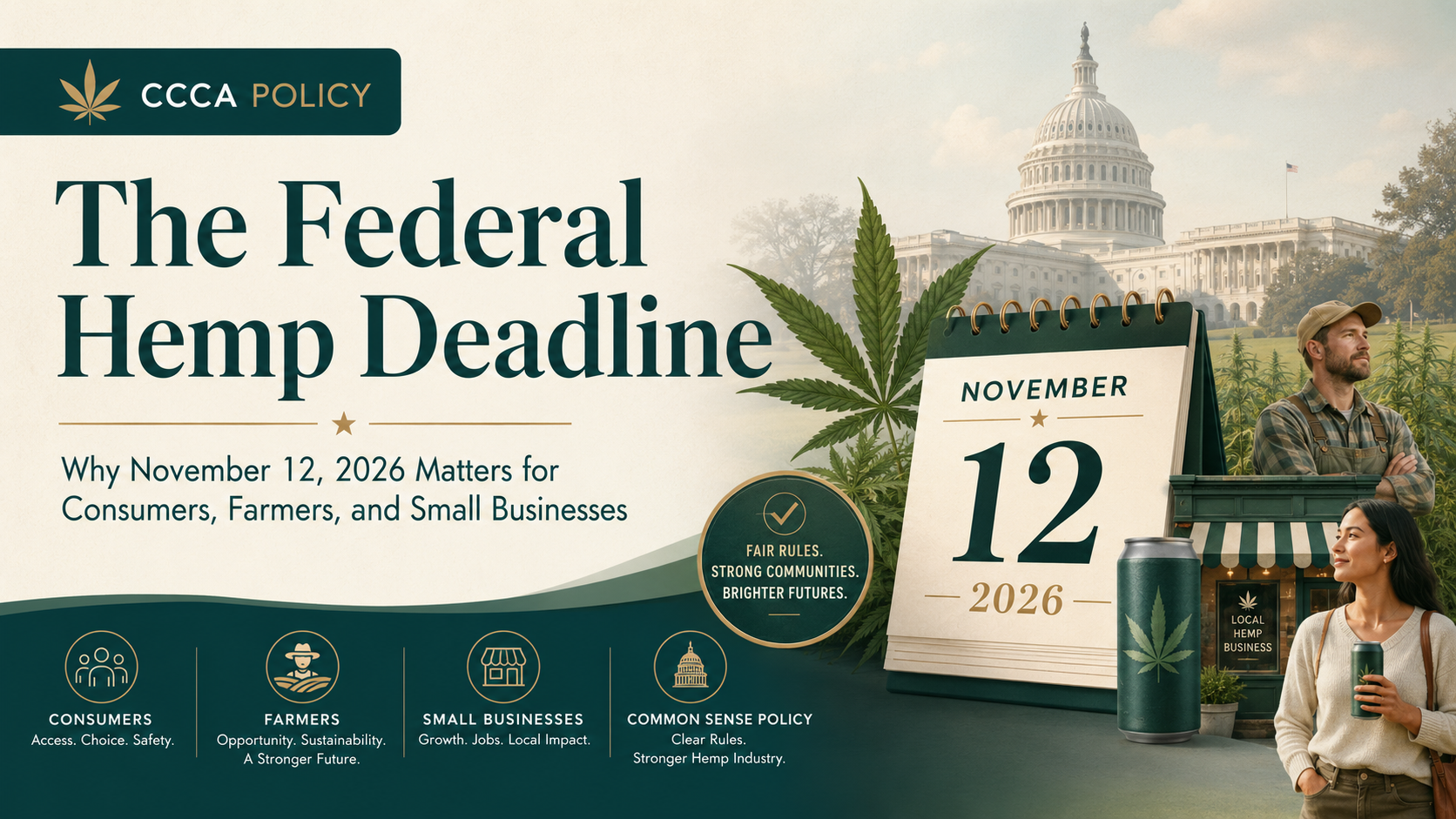
Why November 12, 2026 Matters for Consumers, Farmers, and Small Businesses
In 2018, Congress legalized hemp by defining it as cannabis containing no more than 0.3% delta-9 THC by dry weight. That definition opened the door for farmers, processors, retailers, and consumers to participate in a lawful hemp marketplace.
But that marketplace is now facing a major federal deadline.
A provision passed in the 2025 federal funding package, commonly discussed as Section 781, is scheduled to take effect on November 12, 2026. If Congress does not act before then, federal hemp law will shift away from the 2018 Farm Bill framework and toward a much stricter definition based on total THC, including THCA and certain THC-like cannabinoids. It would also create a very low limit for finished hemp-derived cannabinoid products: roughly 0.4 milligrams of total THC per container.
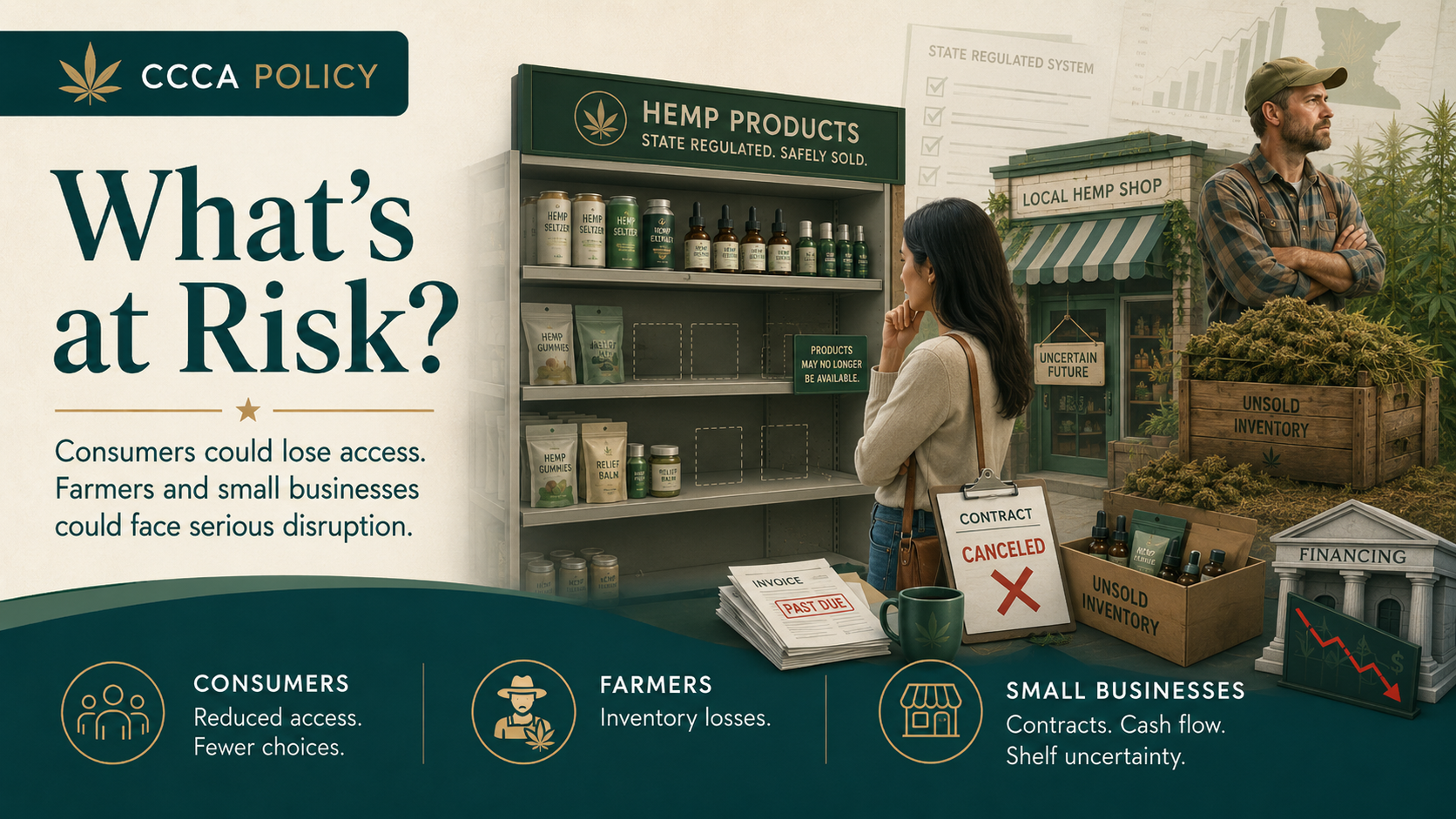
For consumers, this could mean the sudden disappearance of many hemp-derived products that are currently sold legally under state-regulated systems. For farmers and small businesses, it could mean inventory losses, canceled contracts, financing disruptions, and uncertainty about whether products can legally remain on shelves.
CCCA believes the country needs a responsible, transparent, safety-focused hemp framework — not a last-minute federal cliff that pushes consumers toward unregulated markets.
What is the deadline?
The key date is:
November 12, 2026
That is the date the new federal hemp restriction is scheduled to take effect unless Congress delays, repeals, or replaces it.
There is also a second political deadline: the end of the 119th Congress. If bills introduced in this Congress do not become law before the Congress ends, they generally die and must be reintroduced in the next Congress. The Library of Congress explains that a bill that does not become law during the Congress in which it was introduced is considered “dead.”
That means Congress has a limited window to act.
The main federal bills in play
Several bills have been introduced to address the federal hemp issue. They do not all take the same approach.
Some would repeal the upcoming restriction. Some would delay it. Others would create a federal regulatory pathway for hemp-derived cannabinoid products.
1. American Hemp Protection Act — H.R. 6209
The American Hemp Protection Act of 2025 is the clean repeal option. It would repeal Section 781 and prevent the upcoming federal hemp restriction from taking effect. The bill was introduced in the House by Rep. Nancy Mace and referred to the House Agriculture Committee.
What it means:
This is the most direct path for preserving the 2018 Farm Bill hemp framework.
Practical deadline:
It would need to pass before November 12, 2026 to prevent disruption.
2. Hemp Planting Predictability Act — H.R. 7024 / S. 3686
The Hemp Planting Predictability Act is the delay option. The House version, H.R. 7024, would delay implementation of the hemp changes in Public Law 119-37.
This approach would not permanently solve the federal hemp problem, but it would give Congress, regulators, farmers, businesses, and consumers more time to create a workable system. Industry groups have described the bill as a way to extend the implementation timeline for recent federal hemp changes.
What it means:
This bill buys time.
Practical deadline:
It would need to pass before November 12, 2026 to prevent the restriction from taking effect on schedule.
3. Cannabinoid Safety and Regulation Act — S. 3474
The Cannabinoid Safety and Regulation Act would create a federal regulatory framework for cannabinoid products. Instead of banning the market outright, it would regulate products through testing, manufacturing standards, labeling, packaging rules, age restrictions, and other safety requirements.
What it means:
This is a “regulate, don’t prohibit” approach.
Why CCCA should care:
Consumers deserve accurate labels, verified potency, contaminant testing, and clear rules. A regulated pathway is better than pushing products into gray or illicit markets.
Practical deadline:
To prevent disruption, a regulatory framework would need to be enacted before November 12, 2026, or paired with a delay.
4. HEMP Act — H.R. 7212
The Hemp Enforcement, Modernization, and Protection Act, or HEMP Act, would amend the Federal Food, Drug, and Cosmetic Act to create a pathway for cannabinoid hemp products. It was introduced by Rep. Morgan Griffith and referred to the House Energy and Commerce Committee.
This bill is another regulatory pathway option. It focuses on bringing hemp-derived cannabinoid products into a defined federal structure rather than eliminating them entirely.
What it means:
This is a federal product-regulation model.
Practical deadline:
Like the other reform bills, it would need to move before the November 2026 deadline to prevent market disruption.
5. Hemp Safety Enforcement Act — S. 4315
The Hemp Safety Enforcement Act would allow states and Tribes to maintain certain hemp laws and regulatory systems. It was introduced in the Senate by Rand Paul, with Amy Klobuchar and Joni Ernst as cosponsors, and referred to the Senate Agriculture, Nutrition, and Forestry Committee.
This bill matters because many states have already created their own hemp-derived product rules. Some states impose age restrictions, testing requirements, potency limits, licensing, labeling rules, or other safeguards.
What it means:
This is a state-choice approach.
Why CCCA should care:
A state opt-out or state-preservation model could help protect responsible state-regulated hemp markets from a one-size-fits-all federal shutdown.
6. 2026 Farm Bill — H.R. 7567
The House passed the Farm, Food, and National Security Act of 2026, also known as the 2026 Farm Bill, on April 30, 2026, by a vote of 224–200.
The Farm Bill includes hemp-related provisions, particularly around hemp production and agricultural regulation. However, reporting on the House-passed version indicates that it did not delay the scheduled federal restriction on intoxicating hemp products.
What it means:
The Farm Bill is still important, but as currently reported, it is not the clean fix for hemp-derived consumer products.
Why this matters for consumers
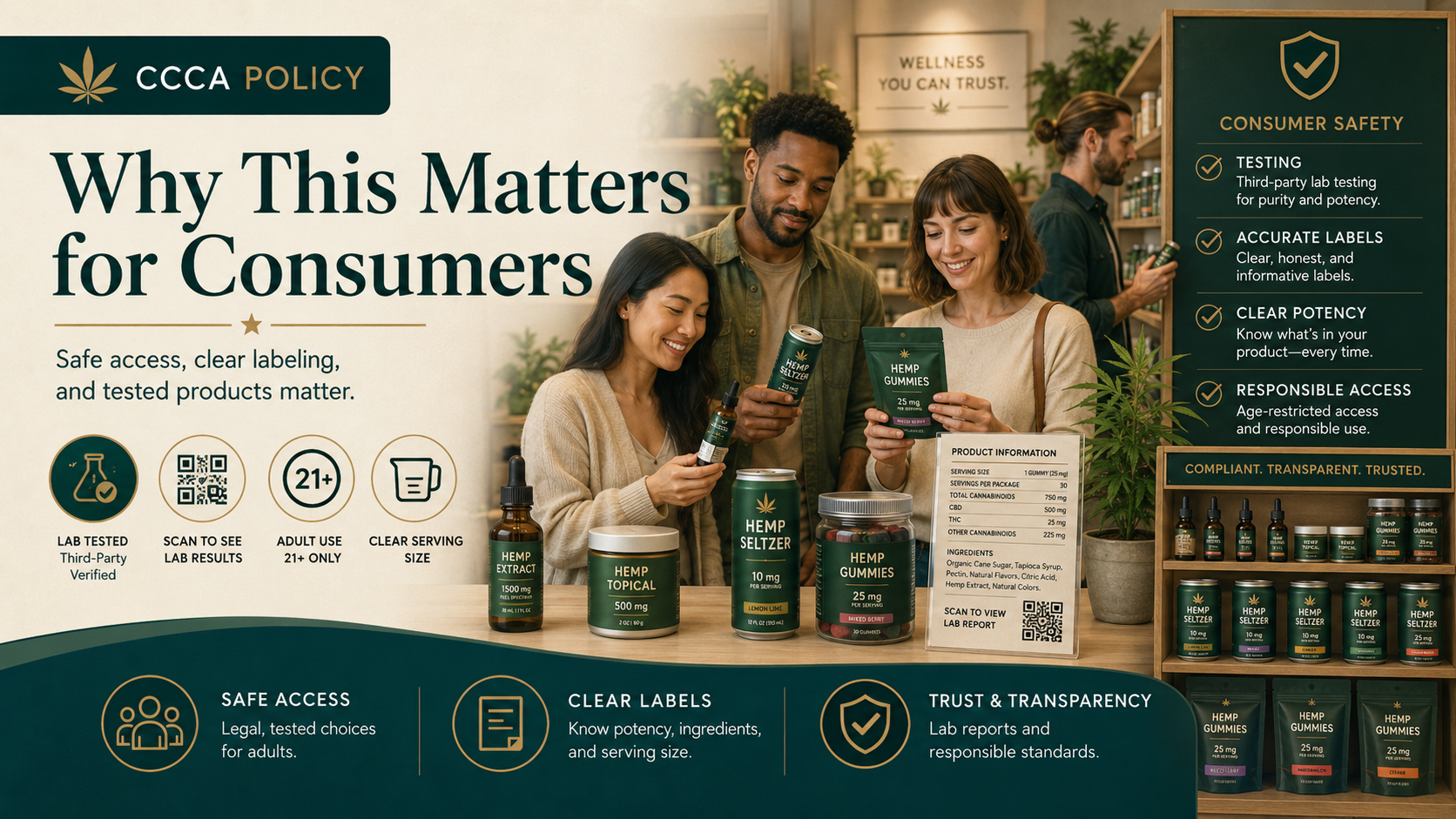
This issue is often framed as an industry fight, but it is also a consumer-access issue.
Many adults use hemp-derived products for relaxation, sleep, pain management, alcohol substitution, or general wellness. Others rely on CBD-rich or full-spectrum products that could be affected by overly broad THC definitions.
If federal law removes legal, tested, labeled products from the market without creating a realistic regulated pathway, consumers may not simply stop using cannabinoids. Some will move to unregulated online sellers, illicit markets, or products with less testing and less accountability.
That is not consumer safety.
Real consumer safety means:
Clear age restrictions
Accurate potency labeling
Contaminant testing
QR-code access to lab reports
Good manufacturing practices
Responsible serving sizes
Packaging that prevents accidental youth access
Enforcement against bad actors
A federal ban without a regulated pathway does not solve the safety problem. It may make it worse.
Why this matters for small businesses and farmers
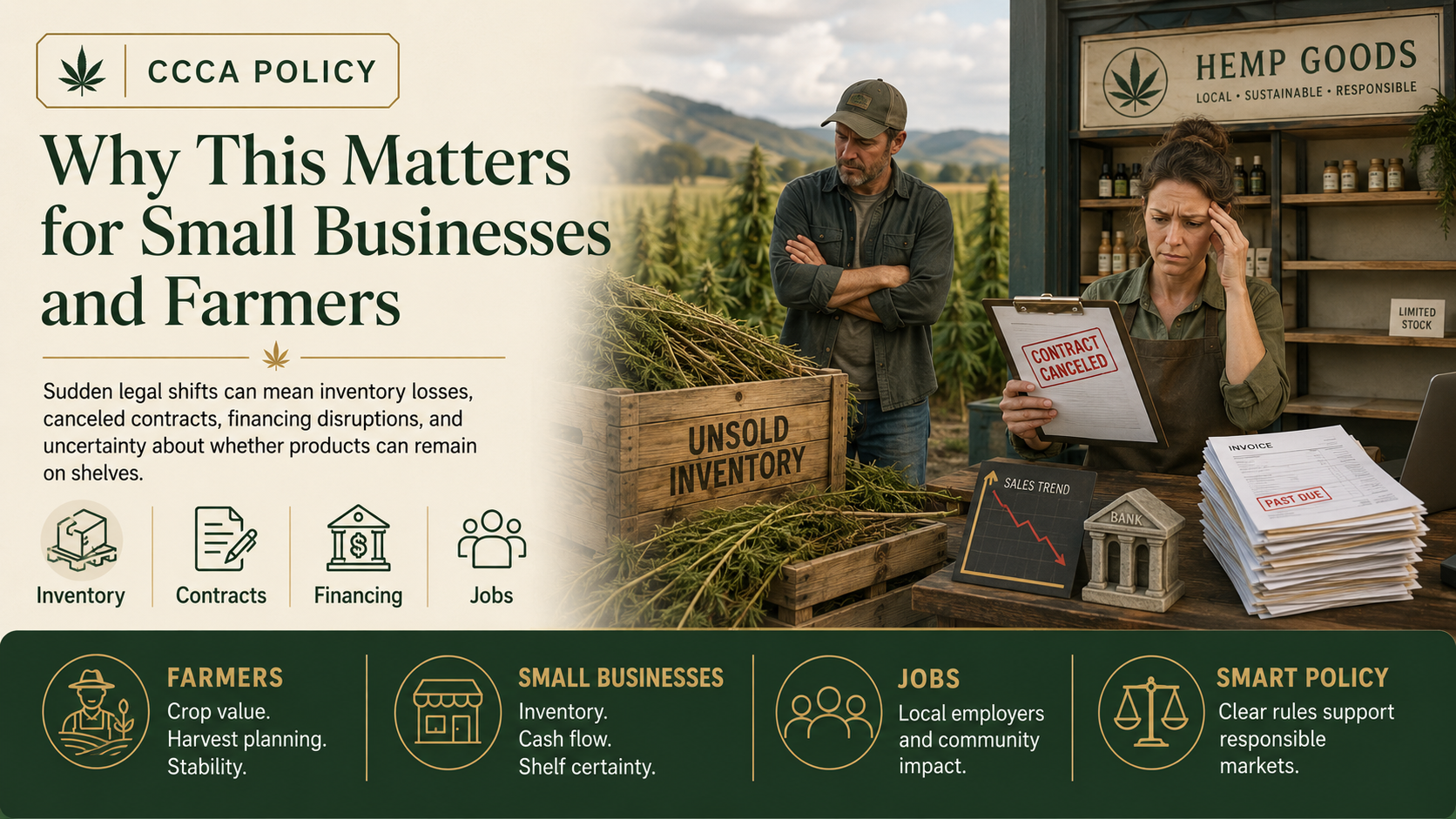
The hemp economy was built around a federal promise: hemp was lawful if it stayed within the 2018 Farm Bill definition.
Farmers planted crops. Processors bought equipment. Beverage companies developed formulations. Retailers built compliant product categories. Labs, packaging companies, distributors, and logistics providers all grew around the legal hemp market.
A sudden federal change could harm more than cannabinoid brands. It could affect:
Hemp farmers
Co-packers and beverage manufacturers
Testing labs
Retail stores
Distributors
Packaging suppliers
Extraction companies
Small rural businesses
Consumers in states with no adult-use cannabis access
This is why Congress should not allow the market to fall off a legal cliff.
CCCA’s position
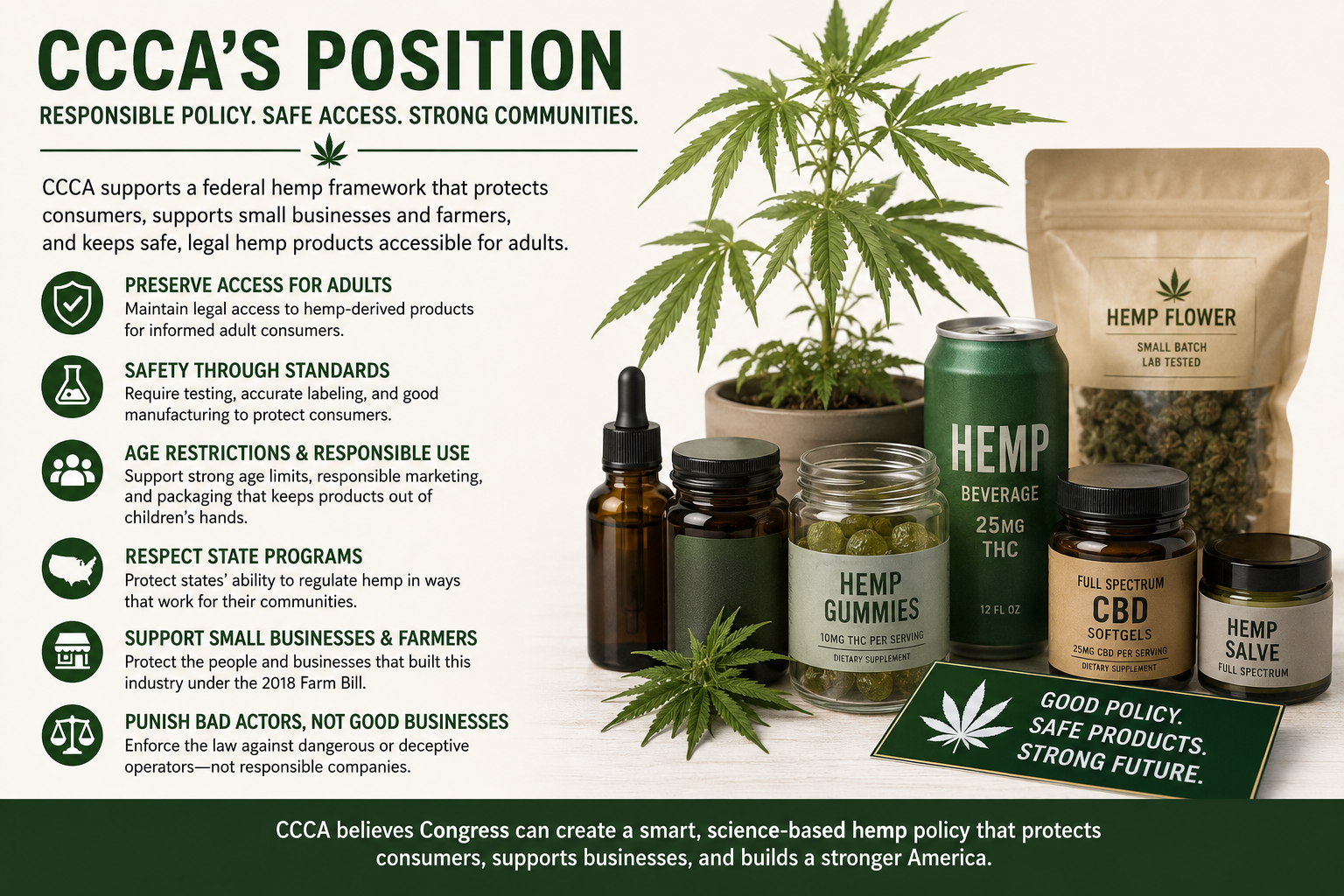
CCCA supports a responsible federal hemp framework that protects consumers while preserving safe access.
We believe Congress should act before November 12, 2026 to avoid unnecessary disruption.
A good federal solution should:
Preserve access for adults to legal hemp-derived products.
Require testing and transparency so consumers know what they are buying.
Set reasonable age restrictions for intoxicating products.
Distinguish intoxicating products from non-intoxicating CBD and full-spectrum wellness products.
Protect state programs that already regulate hemp responsibly.
Support farmers and small businesses that built lawful operations under the 2018 Farm Bill.
Punish unsafe actors without destroying compliant companies.
The choice should not be between prohibition and chaos. The right answer is regulation, accountability, and safe access.
What consumers and stakeholders can do now
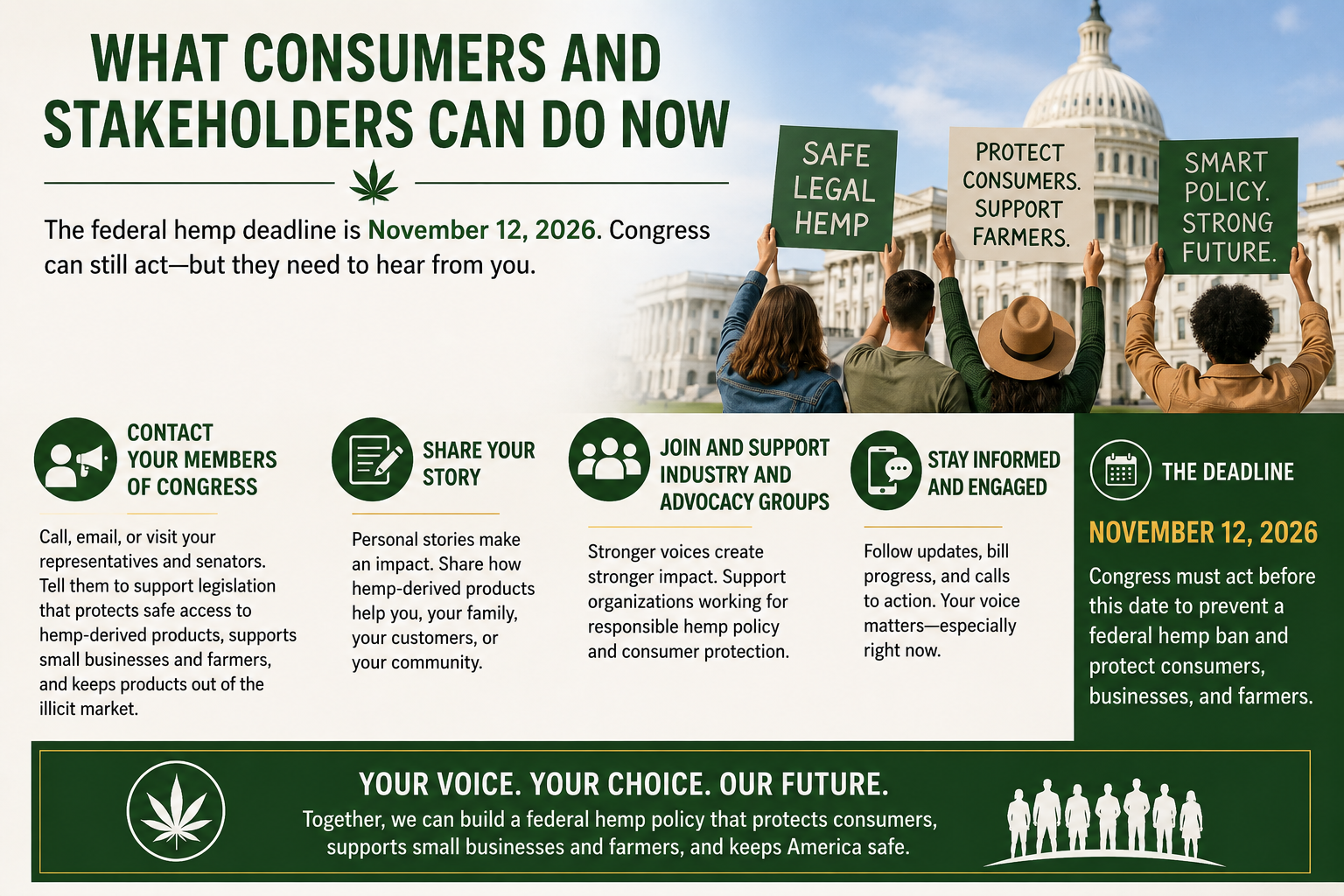
Consumers, farmers, retailers, manufacturers, and advocates should pay attention to these federal bills and contact their members of Congress.
The message can be simple:
Congress should not allow the federal hemp market to collapse on November 12, 2026. Lawmakers should pass legislation that preserves safe adult access, protects responsible small businesses, requires testing and labeling, and creates a clear regulatory pathway for hemp-derived cannabinoid products.
The hemp market needs rules.
Consumers need safety.
Small businesses need certainty.
And Congress needs to act before the deadline.